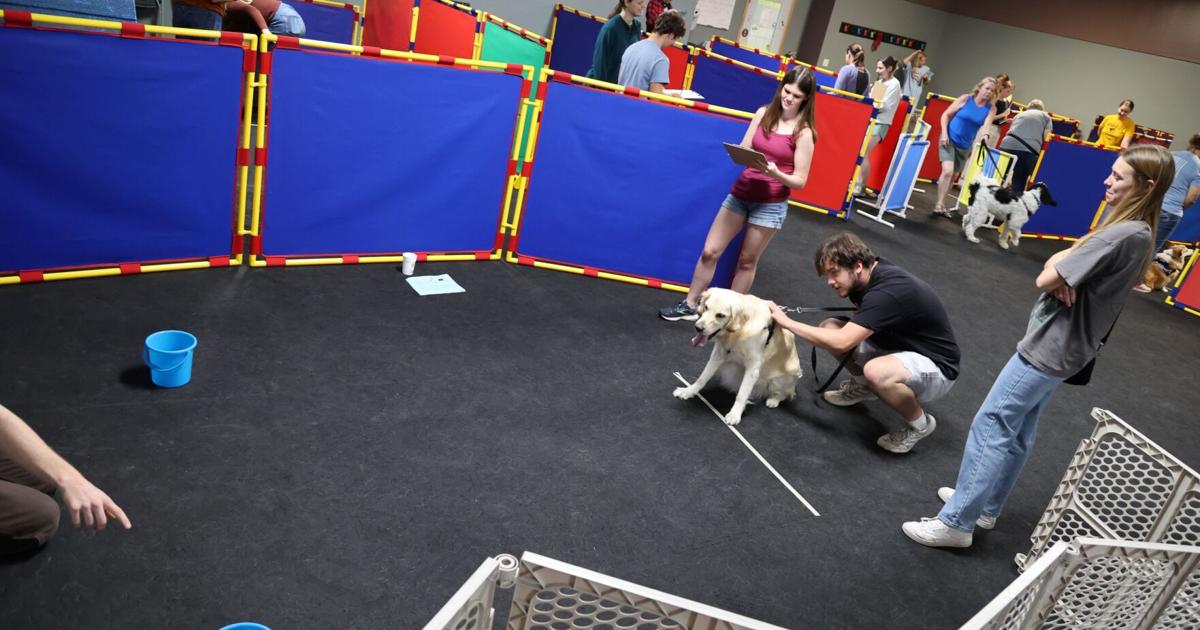
EAU CLAIRE — Researchers at the University of Wisconsin-Eau Claire are continuing their exploration of canine cognition through an annual behavior testing lab at emBARK, a local dog training facility. For the third consecutive year, students collaborated with dogs and their owners to collect data on behavior and cognition in domestic dogs.
Read More
On Wednesday, students Evan Stemper and Bailee Higgins worked with Honey, a 2-year-old golden retriever. Stemper, who previously participated in the lab, reflected on the process of formulating hypotheses about dog behavior based on personality traits. He discussed evaluating various stages of cognitive development, such as object permanence, through a series of tests that involved hiding treats.
“The questionnaire we filled out helps us determine how Honey will behave during testing,” Stemper noted, predicting that she would display traits of a pack-oriented but somewhat lazy dog. Higgins shared her curiosity regarding Honey's attention span during the tests.
The testing methodology draws parallels to child development concepts, particularly the idea of object permanence—the understanding that objects continue to exist when not visible. In the tests, a treat is concealed in a bucket, and dogs are observed as they attempt to locate it, both independently and with guidance. Results indicate varying levels of success, as some dogs struggle to find the hidden treat, possibly due to distractions or differing behavioral tendencies.
Honey showed promising results, successfully locating treats when they were visible. Liam Lamb, a student facilitating the tests, observed, “She was really good at following where the treat was placed if she could see it, which means she has good object permanence. However, she struggled with tracking hidden placements.”
In addition to cognitive assessments, the dogs are evaluated for personality traits. Stemper described Honey as sociable and oriented towards both humans and other dogs, noting her high score in the ‘pack and prey oriented’ category. He commented on how dogs with strong pack drive tended to perform poorly due to distractions from other dogs.
Jenn Smith, a behavioral ecologist at UWEC, emphasized the significance of ongoing research, stating that understanding dog behavior requires acknowledging the variability caused by factors such as weather and recent experiences. “There’s so much variability in how the dogs react. The larger data set really helps us to tease apart which aspects of behavior reflect true biological signals,” she explained.
As this research project continues, it aims to provide a more comprehensive understanding of canine behavior across diverse conditions.