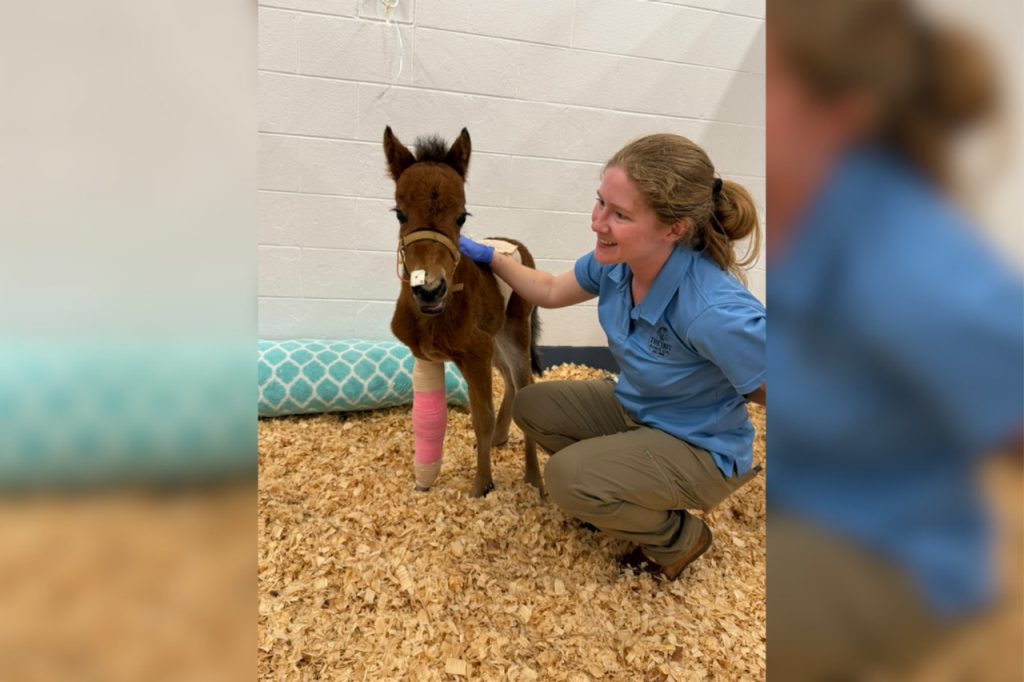
Jerry Ward discovered an orphaned foal while exploring the 5,000 acres where the Grayson Highlands wild pony herd roams near Virginia's highest ridges. Upon finding her nursing from a water bottle, he realized that her mother had likely been gone for days. Ward, part of a nonprofit dedicated to caring for these ponies, took the foal home and named her Little Bit.
Read More
To keep Little Bit alive, Ward provided her with colostrum, the essential first milk for newborns. He pleaded with a closed farm store in Marion for supplies and managed to leave with a bag of colostrum after promising to return the next day. Amidst curious onlookers, he fed her in a Starbucks parking lot before constructing a feeding station back home.
After three weeks, Ward noticed swelling in Little Bit's right knee and took her to the Veterinary Teaching Hospital in Blacksburg. Robert McCarthy, an equine emergency veterinarian, found her to be very weak, with a concerning white blood cell count indicating a likely infection due to bacteria from her umbilical cord.
McCarthy initiated treatment with needle lavage to flush the joint, which allowed Little Bit to regain some vitality. However, further action was needed due to the persistence of the infection. Sophie Bogers, a clinical assistant professor of large animal surgery, explained that the bacteria had settled in the joint, making it difficult to treat with antibiotics alone.
The team decided to perform arthroscopy, a minimally invasive surgery that utilized a camera to inspect the joint closely. They planned to remove infected tissue and the umbilical remnant.
Bogers also consulted Jessica Gilbertie, an associate professor whose lab developed BIO-PLY, a novel therapy aimed at treating biofilms formed by bacteria. This treatment, currently involved in an FDA trial, was particularly relevant because it enhances antibiotic effectiveness.
To accommodate Little Bit's size, the team used an arthroscope designed for dogs. During the surgery, they cleansed the joint and administered strong antibiotics alongside BIO-PLY. Recovery from such infections can be unpredictable, prompting cautious optimism from the veterinary team.
Post-surgery, Little Bit displayed a lively personality and required training to adapt to life as a normal pony, including learning to graze. By early June, she was ready to return home, having surpassed initial expectations for recovery.
Now in a spacious field with two other ponies, Little Bit has adjusted well and is no longer limping. Jerry Ward noted her remarkable return to health, stating, "She's back to a normal little pony."