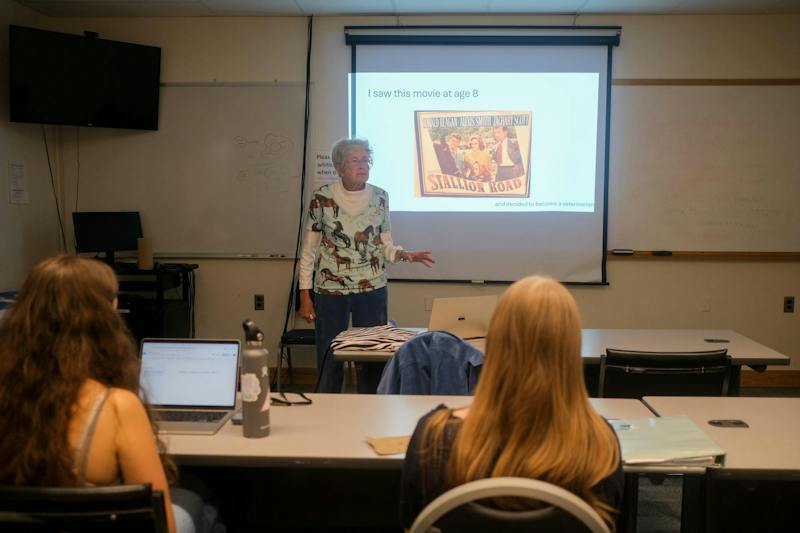
Katherine Houpt, the first woman to achieve a full professorship at Cornell's College of Veterinary Medicine, shared insights into her journey as a veterinary behaviorist during a talk hosted by the undergraduate Animal Behavior Club on September 30.
Read More
In the 1950s, Houpt's first application to Cornell was met with rejection. Nevertheless, she returned to the university as a pioneer in her field. In her presentation, she discussed her motivations for entering behavioral veterinary medicine, her research focus on horses, and the challenges she faced in a male-dominated profession.
Houpt has had a lifelong love for horses, stemming from her childhood experiences connected to her father's military service after World War II. She detailed how her fascination with horseback riding and animals spurred her interest in veterinary medicine.
Her interest in behavioral research was sparked in her early 20s while studying at Penn State University. She discovered a paper detailing how stimuli could influence sexual behavior in domestic turkeys and contacted the author, who encouraged her to pursue veterinary school. Following this advice, she applied to veterinary programs, first facing rejection from Cornell, which was difficult for women of her time.
Eventually, she was accepted into the University of Pennsylvania's veterinary school when it decided to admit a quota of women due to declining interest in the field. Houpt graduated in 1963 as one of only 250 female veterinarians in the U.S.
Despite the early hurdles, the landscape for women in veterinary medicine has changed significantly. Houpt pointed to the passage of Title IX in 1972, which prohibited sex-based discrimination in education, as a catalyst for this change.
After receiving her VMD, she obtained her Ph.D. in behavioral psychology in 1972, focusing on feeding behavior in newborn rats. Following her veterinary practice, she became a professor at Cornell and dealt with pay disparities compared to her male colleagues. She initially taught a course in Women’s Studies before transitioning to animal behavior courses for veterinary students.
Houpt conducted research on equine behavior, including preference tests on bedding materials for horses, determining their preference for deeper bedding over concrete stalls. Her findings indicated that horses were more likely to lie down on bedding and preferred to spend time outdoors with other horses.
Her academic experience revealed that veterinary students were eager to understand animal behavior beyond its biological aspects. She highlighted their interest in behavioral issues faced in clinical settings, which contributed to the expanding focus on behavioral problems in veterinary care.
The event concluded with Houpt addressing specific behavioral issues presented by attendees. She offered practical advice, such as the importance of having multiple litter boxes for cats to accommodate their natural behaviors.
The Animal Behavior Club aims to foster an interdisciplinary community exploring the intersection of behavior and various academic topics, with plans to continue inviting diverse voices from the field.