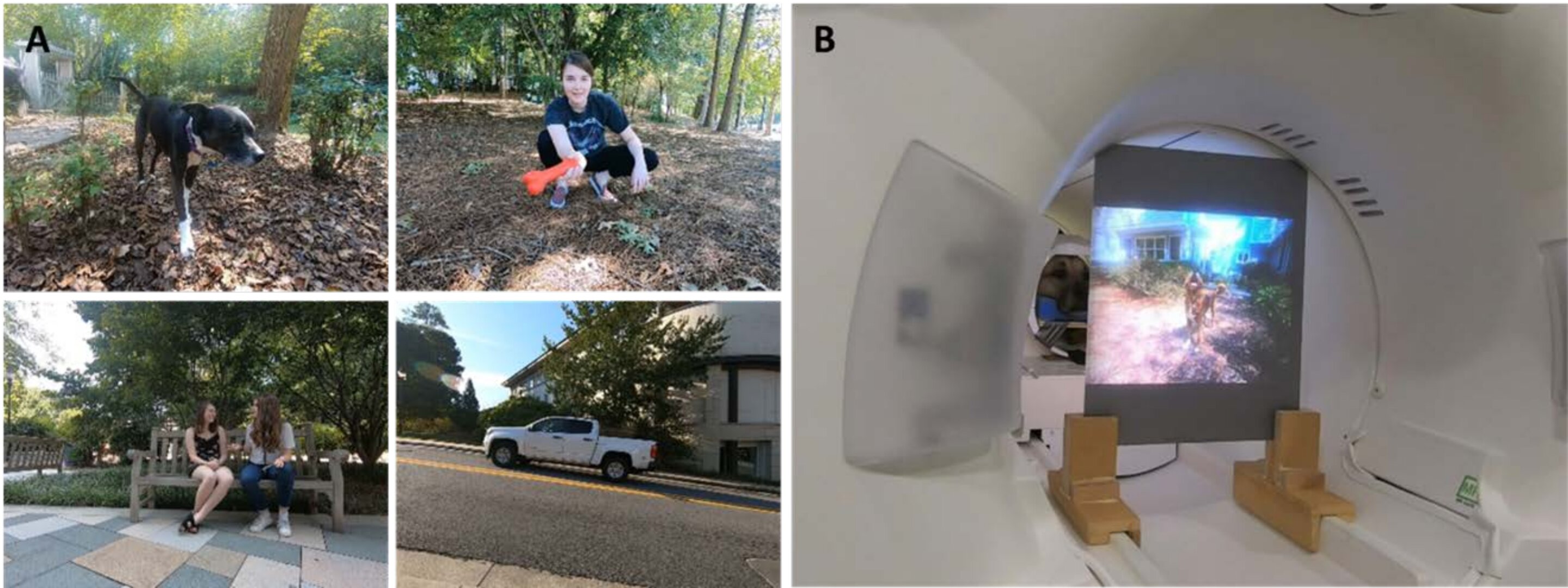
Researchers at Emory University have developed a method to decode visual information from a dog's brain, providing insight into how canines perceive their environment. This study, published in the Journal of Visualized Experiments, involved two dogs, Daisy and Bhubo, who watched naturalistic video clips while undergoing awake fMRI scans.
Read More
The investigation, led by Gregory Berns, a professor of psychology, found that dogs are more focused on actions in their surroundings rather than the entities performing those actions. The research team recorded fMRI data while the dogs watched videos over three sessions totaling 90 minutes, employing a machine-learning algorithm to analyze the resulting neural patterns.
"We demonstrated that we can monitor the activity in a dog's brain while it is watching a video and, to at least a limited degree, reconstruct what it is looking at," Berns stated. Erin Phillips, the paper's first author, emphasized that this research serves as proof of concept, opening the door for further studies on canine cognition and beyond.
The experiment drew inspiration from past advancements in machine learning techniques used to decode visual stimuli from the human brain, though its application to dogs had been limited. Berns' team has long been at the forefront of canine cognitive research, previously publishing work on how dogs process various stimuli such as words, smells, and rewards.
To create engaging video content for the dogs, the researchers filmed scenes of common canine experiences such as receiving affection, treats, and interacting with other animals. The videos were structured into time stamps and classified according to objects and actions. The dogs demonstrated impressive focus, remaining still throughout the sessions without the need for treats.
In comparison, two human participants underwent the same experimental conditions, achieving a high accuracy rate of 99% in mapping their brain data to video content. In contrast, the canine data showed a 75% to 88% accuracy in action recognition, suggesting fundamental differences in cognitive processing between species. Berns noted that while humans tend to classify objects more readily, dogs appear to prioritize the actions taking place.
To Philips, who is also studying ecology and evolutionary biology, understanding how animals perceive their surroundings is crucial, especially in light of her research on predator dynamics in ecosystems. The study includes contributions from other authors, including Emory associate professor Daniel Dilks and undergraduate student Kirsten Gillette.