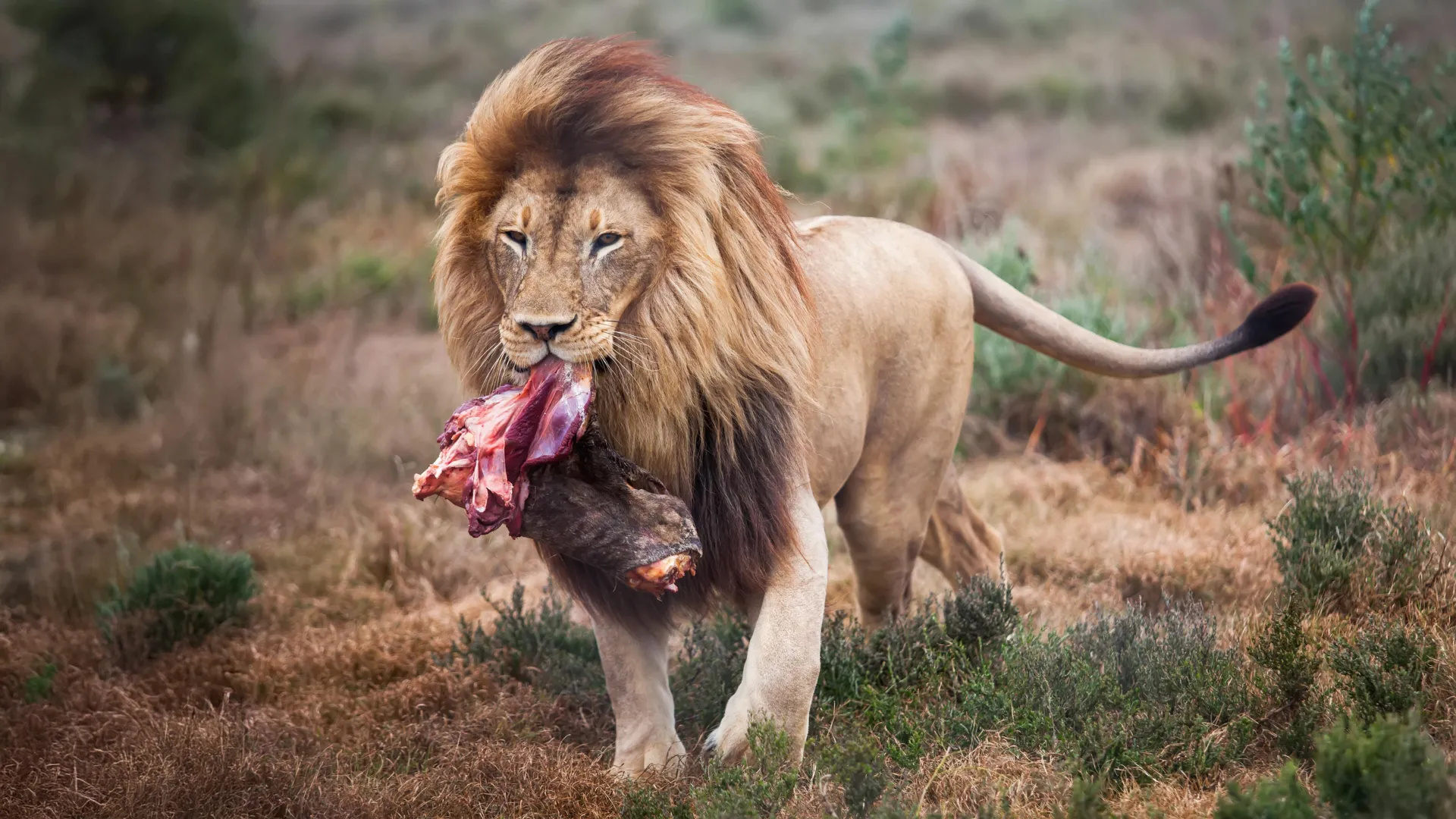
An Australian study indicates that zoo lions exhibit more natural behavior patterns when provided with whole animal carcasses and a feast and fast feeding schedule. This research, published in Applied Animal Behaviour Science, was conducted by Adelaide University in collaboration with Monarto Safari Park in South Australia.
Read More
The study focused on a group of adult male African lions after the addition of whole carcasses every nine days to their usual feeding routine. Continuous video monitoring over three months revealed that the lions spent significantly more time eating during the carcass feeding days, and they rested longer afterward. Their activity levels gradually increased as the fasting periods progressed, mimicking the natural feeding cycles of wild lions.
Lesia Hryhorenko, lead author from Adelaide University’s School of Animal and Veterinary Sciences, emphasized that wild lions do not feed at the same time daily but rather experience natural feasting and fasting depending on hunting success. The study sought to understand how these natural patterns could influence African lions in human care.
The research team, which included Florence Demoulin from the University of Liege, observed three male lions at Monarto Safari Park before and after introducing whole carcasses. During the experimental phase, the lions consumed around 200 kilograms of carcasses, which were available for up to three days, allowing time for rest and digestion.
Using eight infrared cameras, researchers compiled one of the most detailed datasets for African lions in captivity while under a carcass feeding regimen. The findings showed that on carcass feeding days, the lions ate nearly three times longer than usual, engaging in more frequent and extended feeding sessions by tearing and manipulating the carcasses.
Once the lions finished eating, they rested significantly longer, and their activity levels began to rise again as the fasting period unfolded. This pattern closely resembled the feast and fast cycles observed in wild lion populations.
Hryhorenko noted that providing whole carcasses enriches the lions' environment by allowing them to engage in natural feeding behaviors that are crucial for their ecology.
Additionally, the study monitored pacing behavior, which is often linked to anticipation in carnivores. While pacing increased during the observation, it correlated more with predictable events, such as keeper interactions, than with hunger levels. The researchers observed no increase in aggression or disruption of social stability during these feeding events.
Co-author Associate Professor Alexandra Whittaker highlighted the importance of monitoring animal behavior over extended periods when assessing zoo management practices. Traditional studies typically focus on immediate post-feeding behaviors, but this study illustrates that feeding strategies can affect lion behavior for days after.
Future research may integrate behavioral monitoring with physiological data to provide a more comprehensive understanding of how different feeding strategies impact animal welfare.