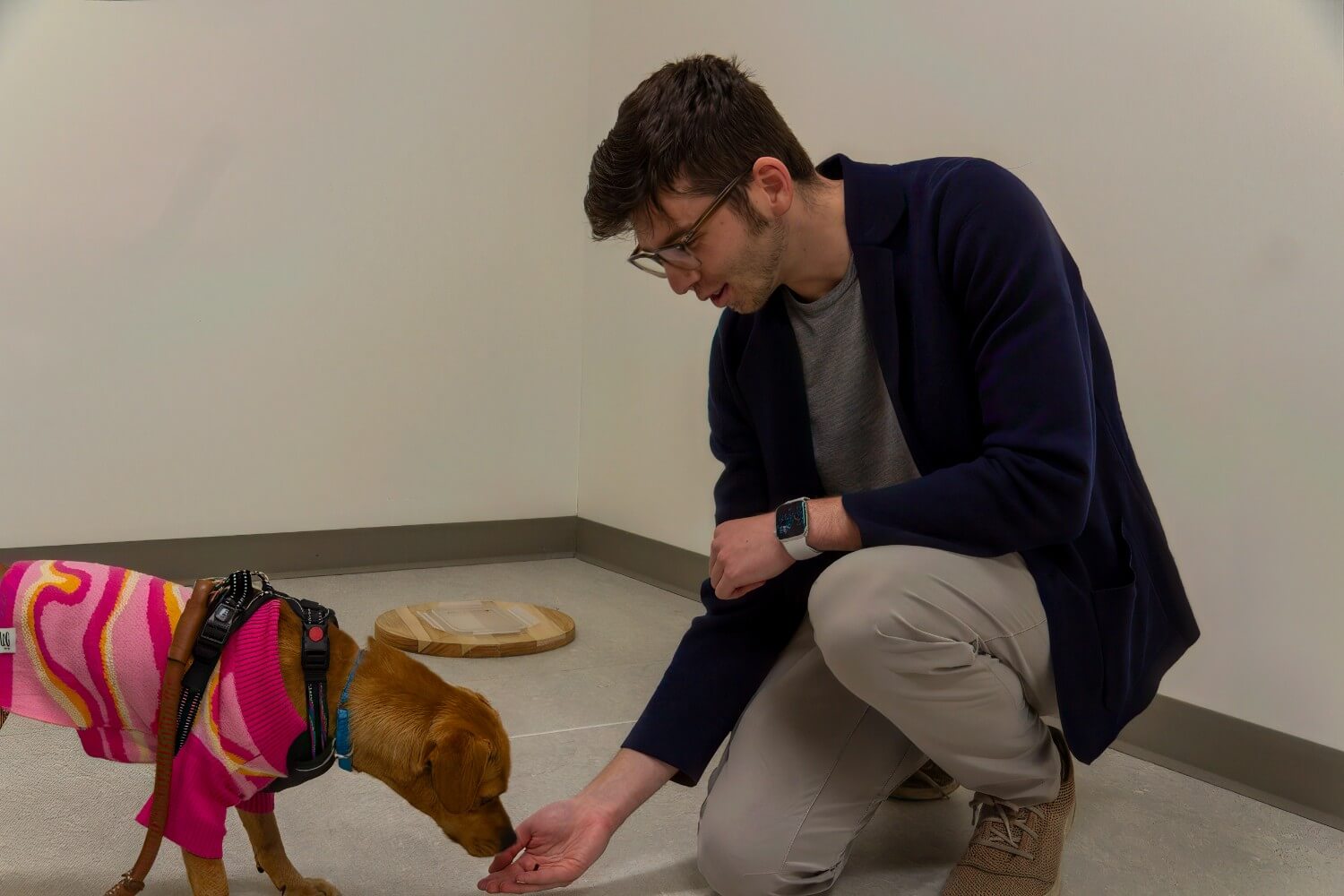
The Canine Intelligence Lab at Occidental College, led by Assistant Professor of Psychology Zachary Silver, is dedicated to researching the cognitive capabilities of dogs and their interactions with humans. In just his second year at Occidental, Silver's work has attracted attention from CBS Los Angeles and the scientific community.
Read More
Silver, who earned his PhD at Yale University, previously established Yale’s Canine Cognition Center during his doctoral studies. He expressed enthusiasm for his role at Occidental, emphasizing the potential of canine cognition research due to its relatively young field. Silver has been involved in designing research projects with undergraduate students since his graduate studies, reflecting on his long-standing ambition to lead a lab as a professor.
He highlighted the emotional intelligence gained through interactions with dogs, noting that they often respond to human emotional cues, aiding self-awareness. Silver explained that this interplay can clarify feelings that individuals might not fully recognize.
Beyond mere measurements of intelligence, Silver advocates for a broader understanding of cognitive abilities, particularly in social cognition where dogs show remarkable skills. According to him, dogs can rival young humans in social interactions, though they may not perform as well in physical reasoning compared to other species evolved for those tasks.
Senior Camden Foster, who is pursuing her own honors research project in the lab, encourages students to participate in Silver's courses on evolutionary psychology and canine cognition, calling the experience unique compared to traditional labs focused on human subjects. Foster plans to transition to a project management role at a cybersecurity firm post-graduation, noting that her lab experience has equipped her with valuable teamwork and organizational skills.
Another senior, Meera Patel, intends to pursue a career in medicine and believes her work in Silver’s lab has enhanced her communication skills, crucial for her future profession. Patel observes that canine cognition research holds relevance for the medical field, particularly concerning the role of service animals.
Silver mentioned that the novelty of canine cognition is appealing to undergraduates seeking research experience, as the field is only three decades old. His aim is to conduct research that benefits both dogs and humans, striving to improve training practices to enhance the well-being of dogs alongside their human companions.