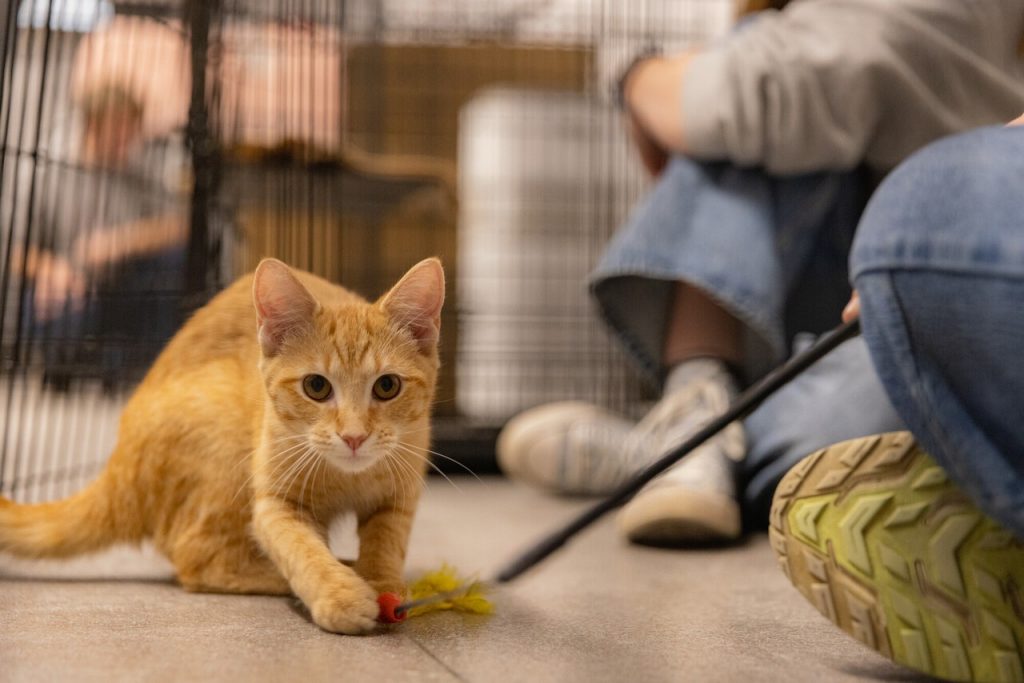
Delilah, a young calico tabby, has transformed from being reluctant to enter her cat carrier to eagerly jumping into it on cue, thanks to the training provided by students Tucker Bugaj and Roya Cranford. This progress exemplifies the goals of the Shelter Cat Behavior and Welfare course at Virginia Tech's School of Animal Sciences, where students gain hands-on experience with feline behavior and welfare while assisting shelter cats in finding homes.
Read More
Cranford, a senior in animal and poultry sciences, praised the training, noting that Delilah's newfound ease with the carrier will reduce stress during her eventual adoption. Nearly 30 students have engaged with 14 cats at a cattery on the Blacksburg campus, employing evidence-based techniques to alleviate stress and enhance behaviors that increase the cats’ adoptability.
Lisa Gunter, an assistant professor leading the course, emphasized its unique nature. "This is one of very few courses in the country where shelter cats live on campus and are trained by students to prepare them for adoption," she stated.
The course also addresses a gap in animal shelter enrichment, primarily focused on dogs, although cats make up a significant percentage of shelter populations. Gunter dispels common myths about cats, stating that many people think cats cannot be trained or do not enjoy human interaction. The partnership with the Lynchburg Humane Society, where the cats come from, enriches the students’ learning experience and the cats' chances of adoption. Jill Mollohan, executive director of the Humane Society and a Virginia Tech alumna, noted that this initiative enhances visibility for the cats and offers them individual attention and support.
Students train the cats to perform various tasks, such as targeting a wand, sitting on cue, and even fist-bumping, using clickers and food rewards as positive reinforcement. Bugaj, who has worked in veterinary settings for six years, remarked on the ease of the training process, stating that cats are responsive to stimuli in a manner similar to dogs, contradicting stereotypes about feline behavior.
Not all cats adapt equally; for instance, Dublin, a tuxedo cat, showed resistance during training, preferring to retreat to a ledge. Despite this, sophomore Keriana Robertson remarked on the potential for training, noting cats can learn like dogs and many enjoy the interaction.
Eva Giguere, a master's student overseeing the daily care of the cats in the cattery, highlighted the importance of enrichment to reduce stress in new environments. Daily sessions engage the cats’ senses with music, scents, and toys.
Ph.D. student Yasmeen Gomez coordinates the adoption efforts, actively promoting available cats and liaising with shelters and prospective adopters. She expressed her satisfaction with the deeper connections formed with the cats and the success in finding suitable homes for them.
The course not only prepares students for veterinary careers but also opens avenues in animal sheltering, behavior consulting, and related fields. Cranford, initially aiming to become a veterinarian, now wishes to focus on cat behavior research, while Bugaj appreciates the practical experience gained in working directly with the cats. Both students agree that witnessing the progression of the cats throughout the course is deeply rewarding.