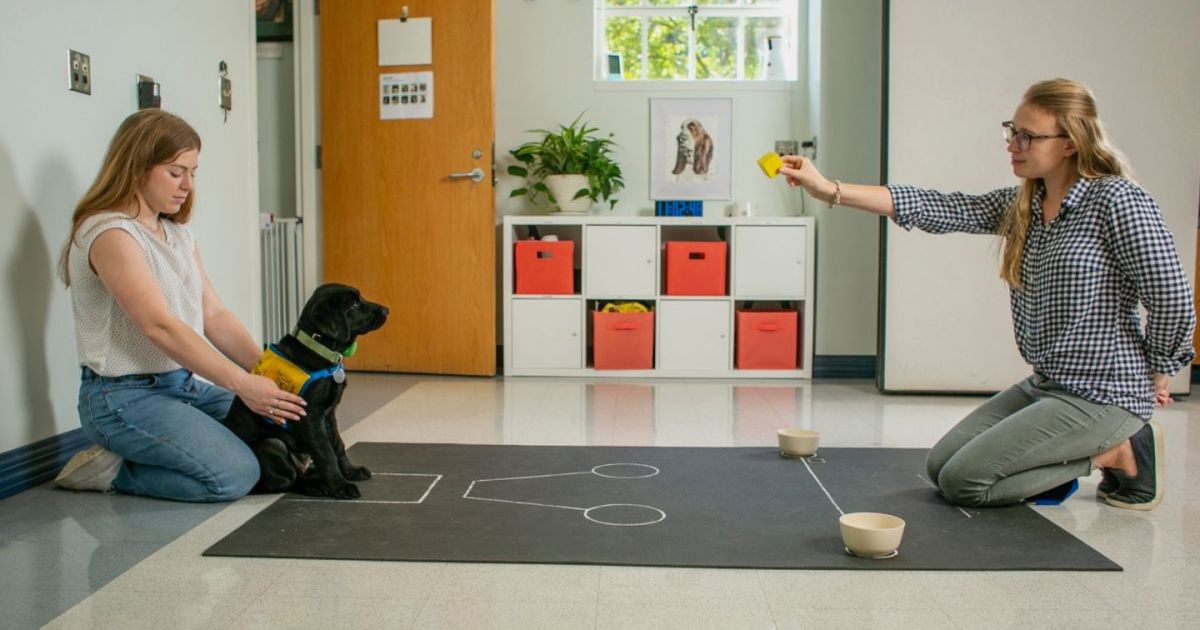
In 2018, Hannah Salomons embarked on a five-year research project involving over 100 puppies training to become service animals. The study, conducted at Duke University, aimed to explore how puppies develop cognitive skills such as memory, impulse control, and interpretation of human gestures.
Read More
Salomons, a Ph.D. student in Brian Hare's Canine Cognition Lab, expressed her long-standing fascination with animal cognition and social communication. The study, recently published in Animal Behaviour, was conducted in partnership with Canine Companions and other organizations, including Ears, Eyes, Nose and Paws and Guiding Eyes for the Blind.
Researchers assessed the puppies, all Labrador and Golden Retriever breeds or their mixes, biweekly from eight to 20 weeks of age. They designed various cognitive tasks to evaluate skills like locating hidden kibble, while investigating whether these abilities develop as part of a unified intelligence or independently.
“This is the largest and most detailed study of puppy cognitive development to date,” said Salomons. Funded by the Office of Naval Research, the National Institutes of Health, and the Canine Health Foundation, the research was supported by interests in cognitive development across species.
Three main findings emerged from the study: firstly, although most cognitive skills develop significantly early, they do so independently and at varying rates. By 16 weeks, nine out of ten cognitive skills tested had emerged, indicating that dogs, much like humans, can possess different strengths.
Secondly, puppies showed signs of being biologically primed for cooperative communication. Skills like understanding basic human gestures developed early in dog puppies but were absent in wolf puppies of the same age. This suggests that domestication has led to specific cognitive adaptations in dogs for better interaction with humans.
Finally, the level of socialization experienced by puppies did not correlate with enhanced cognitive development. Puppies raised on Duke’s campus, exposed to numerous stimuli, demonstrated cognitive development comparable to those raised in typical home environments, implying a biological basis for the timing of these skills.
The findings offer insights into the evolution of cognition in both dogs and humans, supporting the hypothesis that friendly temperaments may have contributed to similar cognitive developments. Salomons noted that just as humans acquire skills for cooperation and understanding gestures early in life, dogs exhibit parallel developmental trajectories.
The research also holds practical implications for service dog organizations, as it might help identify early predictors of success. Currently, only about 50 percent of service dogs pass final evaluations, and early identification of potential can assist in more efficient training and placement.