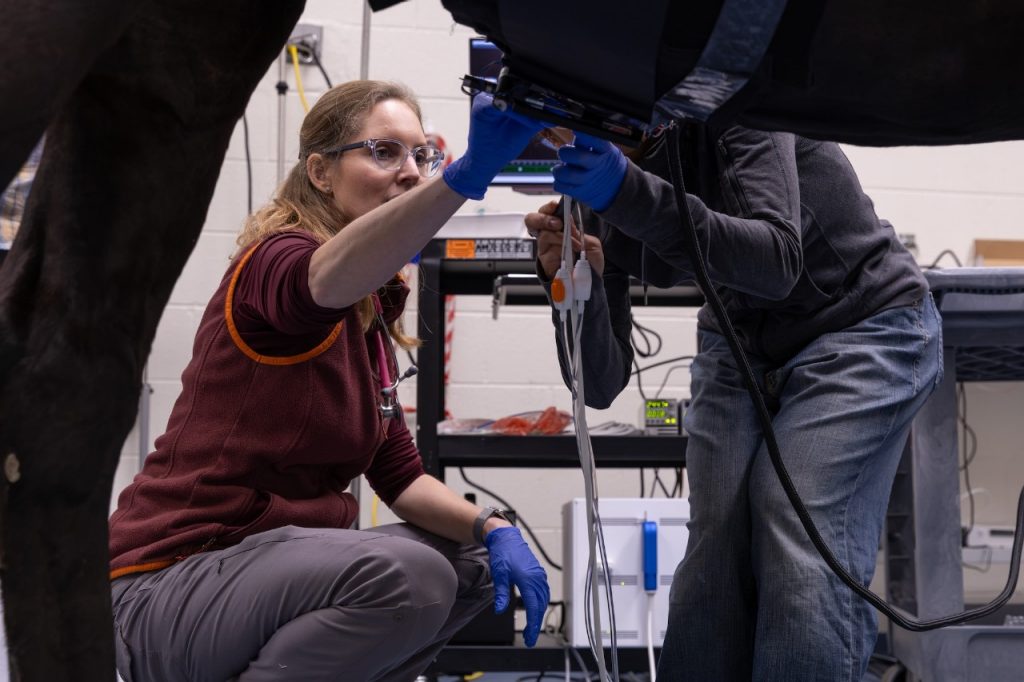
Sophie Bogers, an assistant professor of large animal surgery at Virginia Tech, stated that there is no universal solution for sarcoids, which often require chemotherapy or invasive surgery. However, researchers at the university are exploring a promising alternative: histotripsy, a focused ultrasound technology that produces a bubble cloud capable of breaking down tumor tissue.
Read More
This spring, a team of engineers and veterinarians conducted a test of this technology on Pea, a 9-year-old Hanoverian mare with a tumor on her abdomen. Bogers described Pea as cooperative during the procedure, noting that she appeared comfortable and unbothered by the histotripsy treatment.
Pea's treatment marked the first live trial in a clinical study at the Virginia-Maryland College of Veterinary Medicine to evaluate whether sound-wave technology can effectively manage sarcoids, recognized as the most common and challenging skin tumors in horses. Researchers are still determining if histotripsy can prevent the recurrence of sarcoids, but Pea's experience suggests that the treatment is tolerable for horses awake and standing.
Sarcoids, resulting from a combination of bovine papillomavirus and a horse's genetics, are particularly resistant to treatment. They can cause significant distress and lead to euthanasia in severe cases due to management challenges. Typical treatments involve surgical removal and chemotherapy, but these methods may not be feasible for all cases.
Histotripsy was originally developed for treating human cancers at the University of Michigan and has been adapted for use in veterinary medicine. Joanne Tuohy, an associate professor in surgical oncology at Virginia Tech, has previously employed histotripsy to treat dogs, making horses the next logical subject for the technology. Ultrasound is a highly trusted tool among equine veterinarians, and Bogers aims to create a portable device that can allow immediate treatment of sarcoids upon discovery.
The team is currently developing a more powerful and portable device. They also addressed a challenge: histotripsy requires a water bath for sound wave transmission, which is impractical for standing horses. To overcome this, they designed a solid, gel-based coupling pad similar to those used in routine ultrasound.
Pea's owner, Kelly Kuykendall, became involved in the trial unexpectedly. After her veterinarian detected a small tumor, she learned that participating in the study would allow Pea's tumor to be removed at no cost. Following a smooth overnight stay for the mare, the tumor was successfully removed, with Kuykendall expressing excitement about being part of the pioneering trial.
Although initial results are promising, Bogers emphasizes the need for four more trial participants to complete this phase of the study. She is reaching out to referring veterinarians to encourage participation in the ongoing research, offering to work alongside them on potential cases. Kuykendall encouraged early intervention for sarcoids, promoting the study as beneficial for both animal welfare and veterinary science.