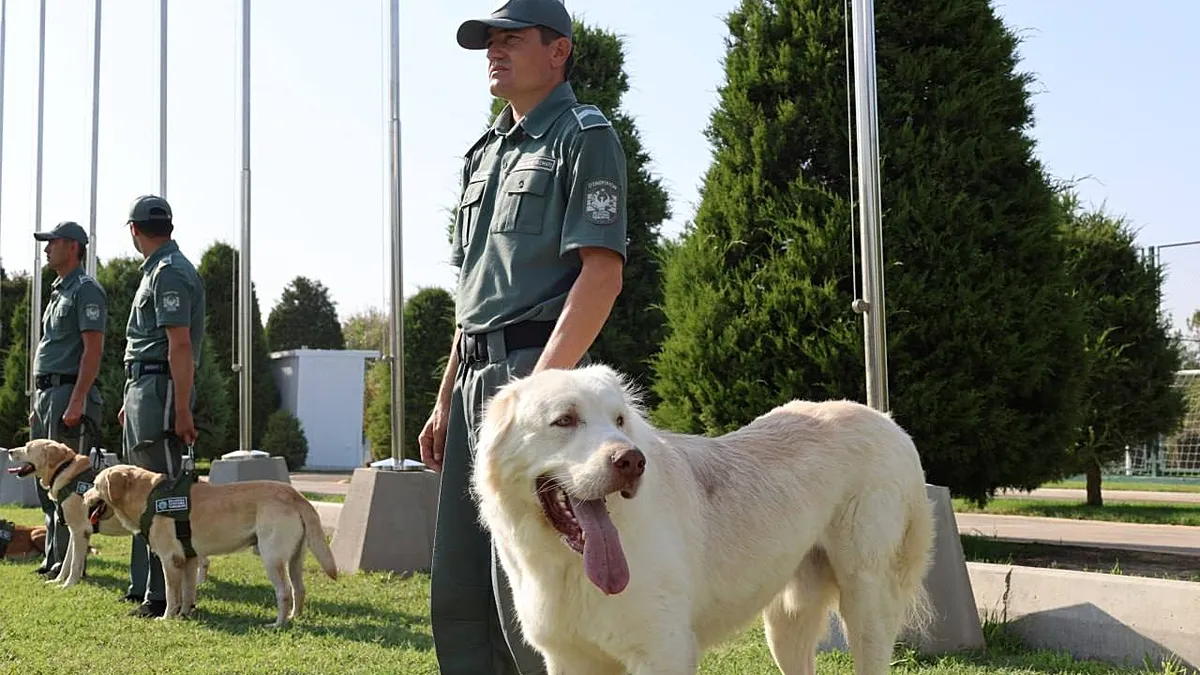
Despite advancements in artificial intelligence and scanning technology enhancing border security, customs services maintain a crucial reliance on trained detection dogs.
Read More
AI systems can assess images and data to identify patterns, aiding customs officers in determining which shipments require further inspection. However, experts at the World Customs Organisation's 7th Global Canine Forum in Tashkent, attended by customs officials and dog handlers from over 50 countries, emphasized the irreplaceable value of scent-detection dogs.
Antonio Lo Parco, head of the WCO's Regional Office for Capacity Building for Europe, stated that dogs possess detection capabilities that AI cannot replicate, and the insights from canine detection can further inform AI systems about emerging trends in customs enforcement.
Oliver Stolper, the UN Office on Drugs and Crime's regional representative for Central Asia, echoed this sentiment, noting that AI tools serve as a complement to the expertise of trained dogs. Stolper highlighted that while AI can identify containers requiring closer examination, “a dog cannot be replaced.”
The role of detection dogs is evolving in response to changes in illicit drug markets, particularly with an increase in synthetic drugs noted by Jonibek Yusupov of Uzbekistan's Agency for the Control of Narcotic Drugs and Firearms. Canine units are adapting their training programs to include scents associated with these new drug types.
For the past three decades, Uzbekistan’s National Canine Centre has been training dogs and handlers for various law enforcement agencies. Established in 1996 and designated as a WCO Regional Canine Centre in 2008, it prepares canine teams for tasks such as detecting narcotics, weapons, and explosives.
However, not all dogs are suitable for service. At around four months old, potential service dogs are assessed for their ability to handle noise, new environments, and heights. Chief instructor Captain Ahmadjon Goyibov explained that the centre primarily utilizes breeds like German and Belgian Shepherds, Russian Spaniels, and Labradors.
Training begins around eight months and lasts six to seven months, with methodologies adjusted based on the dog's temperament. Dogs learn to signal detections through various actions such as sitting or lying down, with Goyibov affirming that the training relies on positive reinforcement rather than force.
Goyibov also noted that love for animals is essential for becoming a proficient handler. In addition to local training, the centre has provided programs for international handlers, having trained 220 professionals from countries including South Korea and Mongolia. Over 200 service dogs have been trained, with some deployed in customs roles outside Uzbekistan.
Elpida Kasapi from the Greek Customs Service remarked that the forum was beneficial for participants to learn about WCO training criteria, which they plan to adapt for use in Greece. According to Uzbekistan's Customs Committee, service dogs from the centre have intercepted over 12 tonnes of narcotic substances from 2023 to the first half of 2026.