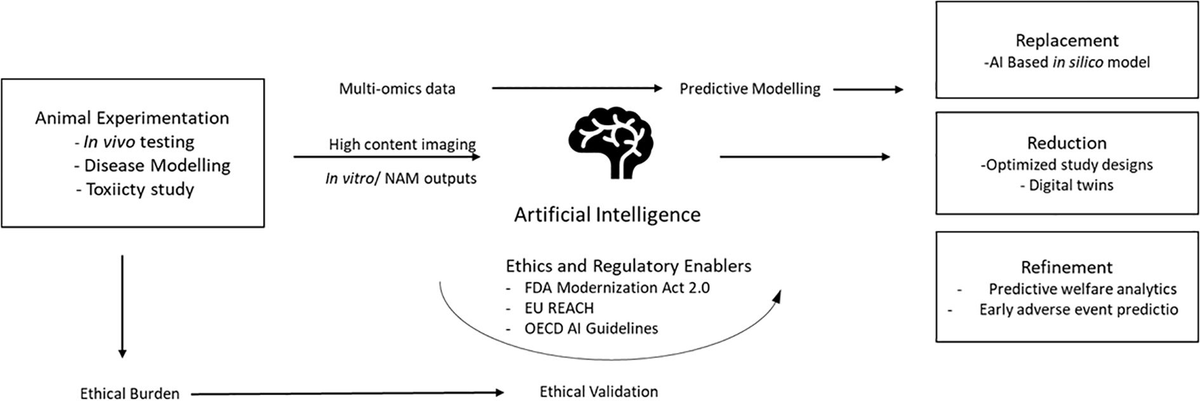
Animal models have historically been central to understanding human physiology and facilitating drug development. However, their limitations, including translational gaps and ethical concerns, have prompted the scientific community to seek alternatives. The “3Rs” framework—replacement, reduction, and refinement—aims to enhance humane practices in research, with artificial intelligence (AI) playing a pivotal role in this transition.
Read More
AI's advanced analytical capabilities enable it to support the 3Rs by providing predictions, simulations, and validations that reduce reliance on animal subjects. Machine learning and deep learning algorithms can analyze extensive datasets to emulate human biological processes, forecast treatment outcomes, and identify potential drug candidates, effectively minimizing the need for traditional animal testing.
Current methodologies leverage AI in various areas of biomedical research, including drug discovery, toxicology, disease modeling, and personalized therapy. Despite the progress, challenges such as stringent validation requirements and ethical oversight necessitate broader interdisciplinary collaboration to implement AI in research models that do not involve animals.
Animal models remain important for studying complex biological systems, particularly in drug development, where they are used to test the safety and efficacy of new treatments. Regulatory bodies often require animal testing to ensure product safety prior to human trials. Yet, 50% to 70% of drugs that show promise in animal studies fail in human trials due to species-specific variations, highlighting the limitations of these models.
Ethical concerns regarding animal welfare are also increasingly scrutinized, prompting calls for a reduction in animal use and the adoption of more humane research methods. In response, there is a growing emphasis on alternating methods such as computational modeling and AI-driven simulations.
AI is transforming the landscape of biomedical research by offering in silico alternatives to animal testing. For example, AI algorithms like DeepTox utilize extensive datasets to predict chemical toxicity, surpassing traditional animal-based approaches in accuracy and efficiency. Additionally, AI enhances organ-on-chip technology, facilitating the study of human disease mechanisms in a more controlled in vitro environment.
Furthermore, AI's ability to process high-throughput omics data supports personalized medicine by identifying potential biomarkers and tailoring treatments to individual patients. The use of integrated AI and computational models improves the accuracy of drug interaction predictions and disease trajectory forecasts.
Ongoing regulatory advances are also noteworthy. In the U.S., the FDA Modernization Act 2.0 recognizes AI and non-animal methodologies as valid substitutes for traditional animal testing, promoting a shift towards performance-based evaluation. Similarly, the European Medicines Agency is developing frameworks to incorporate AI in drug manufacturing and pharmacovigilance.
Despite these advances, several challenges remain. The reproducibility of AI models can be difficult due to variability in training data, and there is a pressing need for high-quality, well-annotated datasets. There are also ethical concerns regarding data use and algorithmic bias that must be addressed as AI becomes increasingly prevalent in biomedical research.
In conclusion, the integration of AI in biomedical research represents a significant opportunity to reduce reliance on animal models, enhance drug discovery processes, and improve disease modeling. Continued collaboration and ethical oversight will be crucial in navigating the future landscape of AI in scientific research.