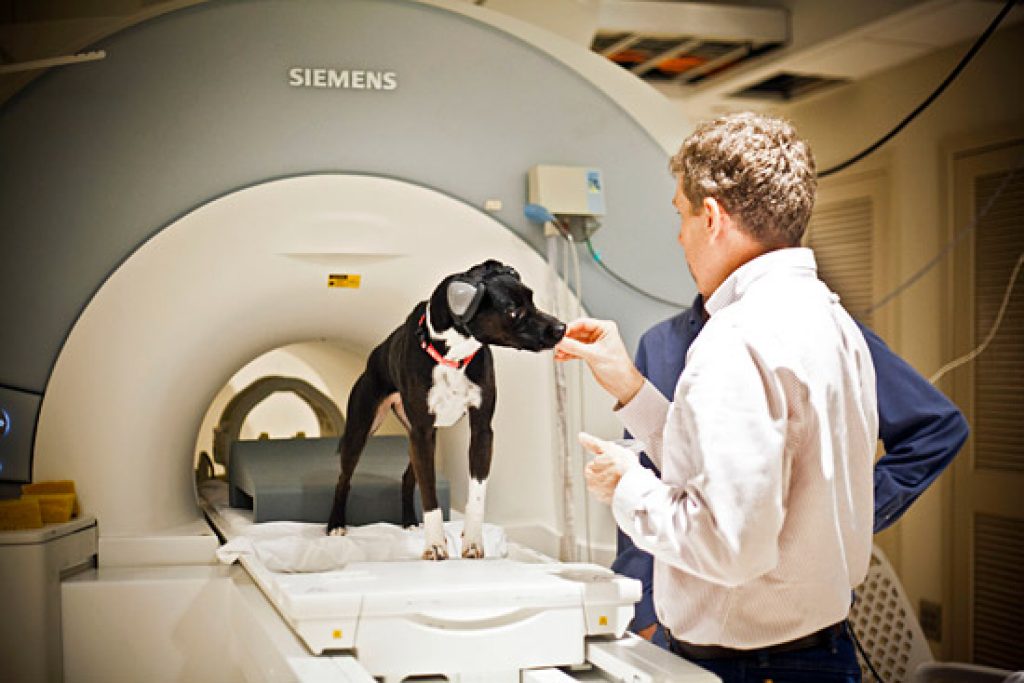
Gregory S. Berns, a distinguished professor of neuroeconomics at Emory University and a New York Times best-selling author, will present his research on canine cognition at the Virginia Tech Carilion Research Institute on May 9 at 5:30 p.m. His talk, titled “What It’s Like to Be a Dog: Using MRI to See How Dogs Think,” is part of the Eric Shullman Distinguished Public Lecture Series.
Read More
Berns has been at the forefront of canine brain research since 2012, training over 80 dogs to undergo MRI scans while awake and unrestrained. The initiative aims to understand how dogs' brains function and what they perceive about humans. Berns noted in a 2013 New York Times Sunday Review that his conclusions suggest that dogs share emotional experiences similar to humans, stating, "Dogs are people, too."
The first dog to undergo training was Callie, Berns' terrier mix, whom he trained in an MRI simulator at home. The dogs wear ear protection during the scanning process and are not sedated, participating voluntarily. The training techniques have led to significant findings that show dogs can recognize familiar scents and faces, activating the caudate nucleus, a brain region associated with emotions and preferences in humans.
Berns explained that the level of brain activity in response to social interaction suggests dogs experience emotions of love and attachment that go beyond mere food motivation. His research indicates that dogs may prefer praise over treats, with these results published in the journal Social Cognitive and Affective Neuroscience.
Currently, Berns is investigating decision-making processes in dogs and aims to predict the success of service dogs. Michael J. Friedlander, Virginia Tech's vice president for health sciences and technology, praised Berns as a leading innovator in cognitive neuroscience whose work offers profound insights into the social bonds between dogs and humans.
Berns, who directs both the Center for Neuropolicy and the Facility for Education and Research In Neuroscience at Emory University, has authored three books, with his fourth, “What It’s Like to Be A Dog,” set to release in September. Prior to his academic career, Berns served as a supervising physician for Comprehensive Substance Abuse Services in Greensburg, Pennsylvania. He holds an undergraduate degree in physics from Princeton University, a doctoral degree in biomedical engineering from the University of California, Davis, and a medical degree from the University of California, San Diego.