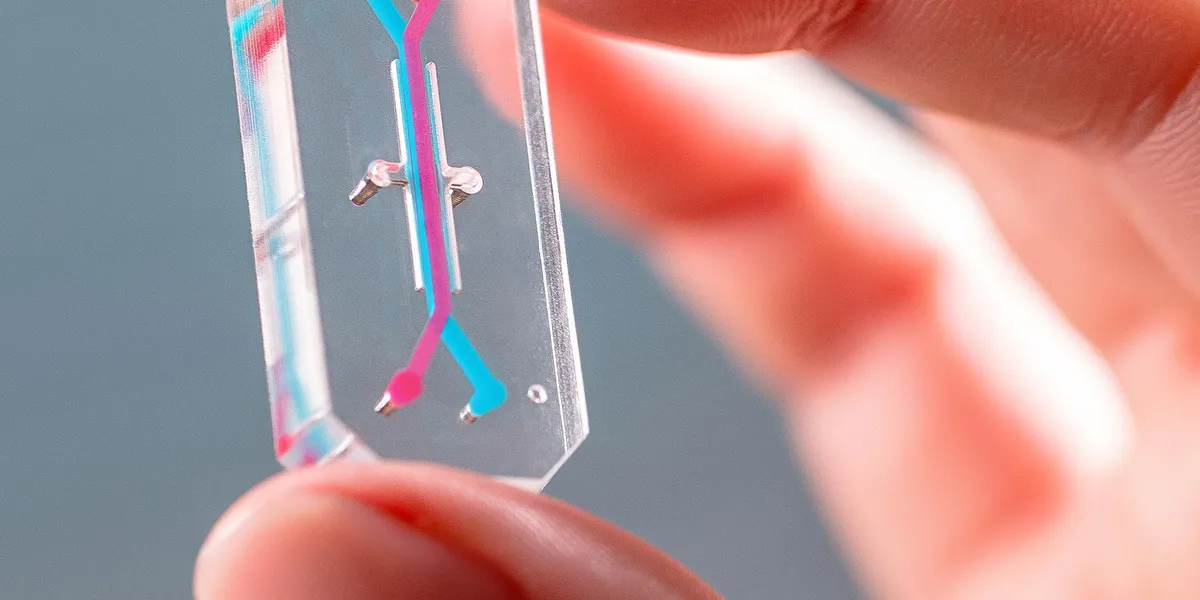
Animal testing has long been a foundation of biomedical research and drug development, but innovative technologies such as Emulate’s Lung-on-a-Chip are now designed to replicate human biology without animal involvement. Seventeen years ago, Donald Ingber and his colleagues at Harvard University’s Wyss Institute introduced a groundbreaking model of a human lung—a small device made of clear polymer with channels lined with lung cells. This model not only mimicked the physical movements of breathing but also responded to stimuli like inflammatory proteins, demonstrating potential for drug testing.
Read More
Despite the promising results, the initial paper was rejected by Science, with editors suggesting that animal testing should first validate the model. Ingber's team complied and resubmitted their research, which was eventually published in 2010. This incident highlighted the entrenched reliance on animal models in biomedical research.
A recent case from Ilka Maschmeyer, a toxicology researcher at the German biotech firm TissUse, illustrates changing times. TissUse specializes in organ-on-a-chip technologies, which pharmaceutical companies are beginning to use. One company was denied FDA approval for a drug trial because they provided only animal data; the FDA requested results from organ-on-a-chip systems instead, indicating a shift towards acceptance of alternative methods.
Collectively known as NAMs (new approach methodologies), these alternatives are garnering attention, although many have yet to undergo rigorous validation. As NAMs evolve, their implementation challenges are shifting from technical feasibility to practical application and regulatory acceptance. Thomas Hartung, a toxicologist at Johns Hopkins University, commented on the complexity of transitioning from animal models to NAMs, indicating that change management is as crucial as the technology itself.
Historically, animal experiments have been questioned for their ethical implications and efficacy, with approximately 92 percent of drugs in U.S. clinical trials failing. While flawed study designs contribute to this high failure rate, there is consensus that animal models do not consistently predict human responses. The advent of more sophisticated alternatives—such as organoids and linked organ-on-a-chip systems—offers greater fidelity to human biology.
Regulatory advancements also signal a notable change. The FDA Modernization Act 2.0, passed in late 2022, allows the use of NAMs in preclinical studies, opening doors to alternatives previously restricted by regulations mandating animal testing. In 2025, the FDA committed to making animal studies less common and signaled plans to revise drug development rules to include nonclinical tests.
Moreover, the National Institutes of Health has directed researchers applying for animal model grants to incorporate nonanimal approaches, while both the European Commission and UK plan to phase out animal testing.
For NAMs to be widely adopted, their reliability must be established through validation processes, which will confirm their capability to produce consistent results across different contexts. Ingber noted that the standards and quality control of these NAMs must be robust to gain FDA acceptance.
Evidence is building that some NAMs may outperform traditional models. For instance, Emulate's liver-on-a-chip flagged many drugs that passed animal trials but proved toxic to human livers. However, validating these systems remains challenging, often requiring extensive studies with significant resources.
Despite these hurdles, a cultural shift within scientific research is essential for the acceptance of NAMs. Current infrastructures remain heavily tied to traditional animal testing, with many researchers skeptical of alternatives. Initiatives aimed at educating scientists about NAMs are underway, as demonstrated by training programs offered by the NIH and FDA.
As younger scientists emerge who are more accustomed to using NAMs, there is potential for a significant change. However, it remains to be seen how these methodologies will integrate into broader scientific research areas beyond drug development, where the application of NAMs may be less straightforward. Ingber advocates for collaboration between academia and industry to evolve both the technologies and the regulatory frameworks necessary for the future of biomedical research.