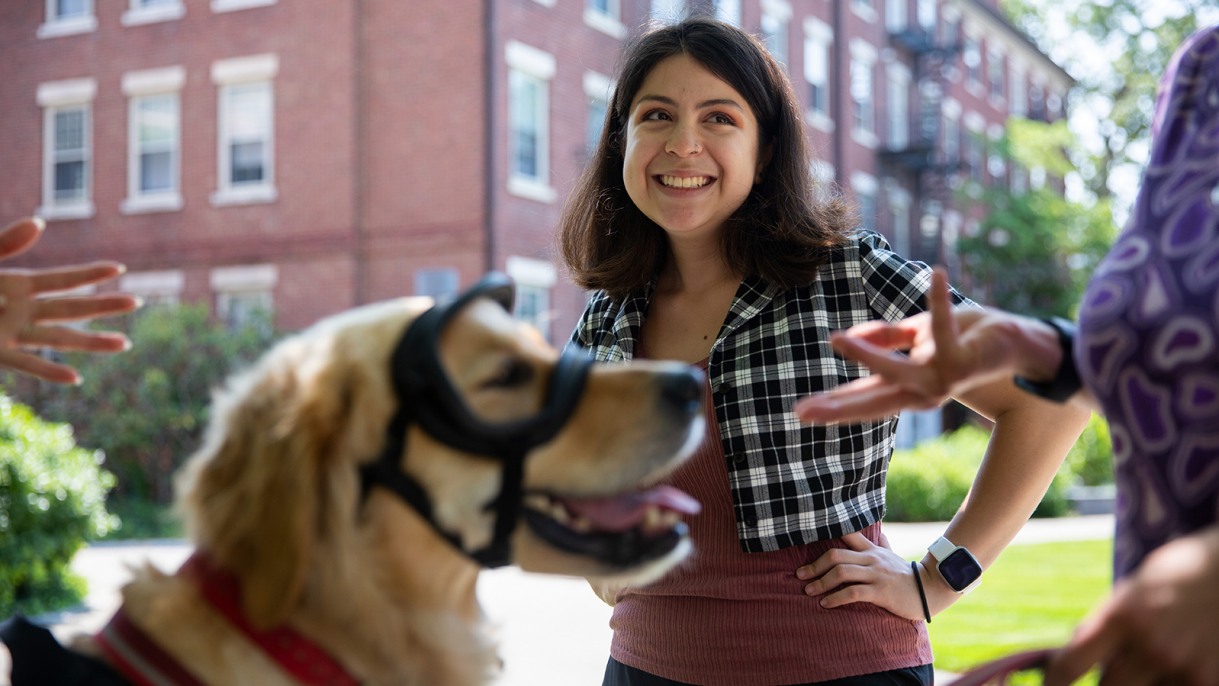
Sarah Zylberfuden is involved in two key studies focused on canine cognition at Brown University. The first study examines how dogs visually navigate environments constructed by humans. Researchers use eye-tracking goggles on the dogs to analyze what they observe and where they focus their gaze. Participants train their dogs to wear the goggles before taking them on walks with researchers, marking an initial step toward understanding how dogs perceive and interact with their surroundings.
Read More
The second study, conducted via Zoom, looks into the factors influencing dogs' food preferences. During sessions, Zylberfuden guides participants in offering familiar foods to their dogs while predicting their choices. Additional tasks involve dogs pawing at levers for treats, aimed at assessing their problem-solving abilities.
Dogs have been integral to human life for tens of thousands of years, serving roles from companionship to aiding in search-and-rescue operations and supporting individuals with disabilities. Research like Zylberfuden's is essential for examining the cognitive abilities shared between humans and dogs.
“It’s important to understand different things around us, rather than just people,” Zylberfuden said. She noted that understanding how dogs interpret cues and solve puzzles might shed light on similar processes in human infants.
Zylberfuden's work takes place in Buchsbaum’s laboratory at Brown, which is affiliated with the canine cognition labs at the University of Toronto where Buchsbaum was an assistant professor until 2020. Zylberfuden pursued the SPRINT Award to join Buchsbaum's research project titled “How do dogs think and learn about the social and physical world around them?” Driven by her passion for dogs—she owns seven—she felt compelled to participate.
“Before this, I had a limited understanding of the science behind studying dog behavior,” Zylberfuden said. “I found it fascinating to employ research methods to explore how dogs learn.” With prior experience in children's cognition, she saw this project as an opportunity to broaden her research in cognitive neuroscience.
Zylberfuden emphasized the potential for significant discoveries about both humans and dogs. “There are many unanswered questions regarding dogs and humans that could enhance our understanding of these creatures that are present in our lives,” she stated. “This research also has implications for understanding ourselves.”
In addition to her interest in cognitive neuroscience, Zylberfuden is drawn to literary arts. She appreciates how writers create different worlds based on their unique experiences. By combining her studies in cognitive neuroscience with her interest in literature, she aims to delve into the connections between these fields. She plans to take a course titled “Neuroaesthetics and Reading” next year, which focuses on the brain's activity during reading and writing.
Zylberfuden is eager to explain to others why her dual focus is valuable, noting that it is about making connections between seemingly unrelated areas—like the relationship between dogs and humans—and understanding how these connections can enrich both fields.