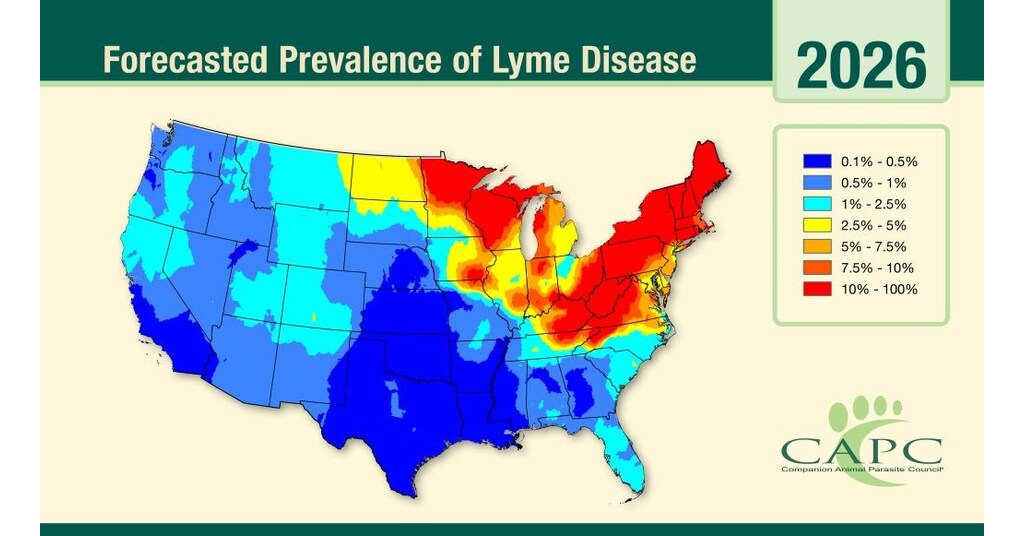
The Companion Animal Parasite Council (CAPC) has released its 2026 Pet Parasite Forecast, which indicates a significant geographic expansion of vector-borne diseases such as Lyme disease, ehrlichiosis, anaplasmosis, and heartworm across the United States. This expansion extends into areas previously considered low or moderate risk, raising concerns about implications for both pet and human health.
Read More
CAPC's forecasts, informed by over a decade of disease surveillance and data from more than 10 million veterinary diagnostic tests annually, have historically maintained over 94% accuracy. These forecasts serve as both a national and county-level early warning system, providing crucial insights for veterinarians and public health officials alike.
Kathryn E. Reif, MSPH, PhD, an Associate Professor in Parasitology at Auburn University and CAPC Board Member, emphasized that changing land use, pet travel, wildlife dynamics, and climate change are driving shifts in the distribution of disease vectors. She noted that these forecasts will assist veterinarians in enhancing year-round prevention efforts tailored to local risks.
The report reveals that Lyme disease risk is notably expanding, particularly from its historical hot spots in the Upper Midwest and Northeast into states like Ohio, Kentucky, West Virginia, and North Carolina. The areas of increased risk for dogs closely correspond with where human cases are reported, highlighting the interconnectedness of pet and human health.
Craig Prior, BVSc, CVJ, another CAPC Board Member, stated that rising cases of vector-borne diseases in dogs can signal similar environmental pressures affecting humans. He cautioned that veterinarians need to enhance tick prevention strategies where Lyme disease risk is on the rise.
Heartworm disease, primarily transmitted by mosquitoes, remains widespread in the Southeastern U.S. and is also moving north along the Mississippi River corridor and the Atlantic coast. Areas in the Mountain West and Northern California, once not considered endemic, are now showing elevated heartworm risk, attributed to factors like the movement of infected dogs and urban development.
The forecast predicts sustained high risks for ehrlichiosis and anaplasmosis as lone star ticks and brown dog ticks expand their territories. This includes increased ehrlichiosis risk in the Southeast and South-Central U.S. and a northward movement of lone star ticks.
Dr. Prior emphasized the need for continuous year-round prevention and annual testing to combat these expanding risks. He stated, "Ticks don't feed 365 days a year, but they do feed 12 months a year. 'Low risk' does not mean 'no risk.'"
CAPC stresses the importance of routine diagnostic testing to assess local risk levels for parasitic diseases. Their forecast maps aim to identify gaps in prevention and areas of emerging risk.
In an effort to assist veterinarians and pet owners, CAPC provides resources such as 30-Day Parasite Forecast Maps and Daily Flea Forecasts on their website, www.PetDiseaseAlerts.org, which detail local parasite activity based on environmental conditions. These tools are intended to help tailor prevention strategies to combat local threats.
The CAPC, established in 2002, is a nonprofit organization consisting of experts in parasitology, veterinary medicine, and public health, dedicated to optimizing parasite management practices for pets and reducing zoonotic disease risks.