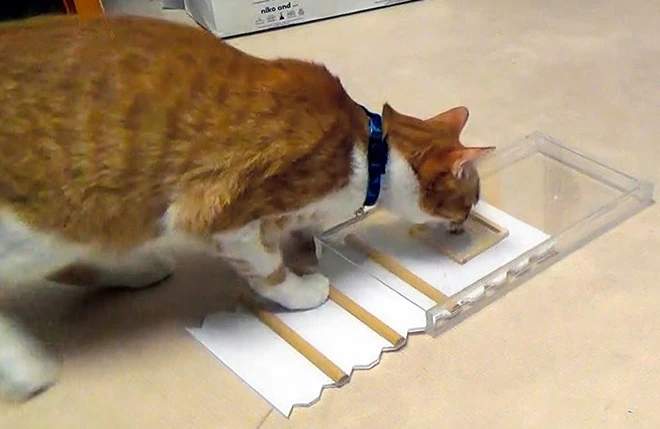
A recent study has determined that cats do not change their behavior to solve problems even after observing humans. Conducted by a team led by Minori Arahori, a researcher from Anicom Specialty Medical Institute Inc., the research aimed to examine whether cats could learn by imitation, a trait noted in dogs and other animals but previously untested in felines.
Read More
The experiment involved tasks where cats needed to retrieve food from a drawer and a tube. During the drawer task, 45 cats were selected from homes and cat cafes, but 15 were removed due to lack of motivation. The remaining 30 were divided into two groups; one watched a human demonstrate the retrieval method while the other did not. Only two cats in each group successfully obtained the treat, indicating that the demonstration did not influence their behavior.
In an additional test with a transparent tube containing food, the team observed 40 cats with the same result: no significant difference was found between the groups regarding their attempts to access the food.
The researchers speculate that the differences in behavior between dogs and cats may stem from varying domestication processes. While dogs have been selectively bred for obedience to humans, no such selective breeding has occurred for cats. "Dogs are trained to be docile while cats are not trained in the same way," Arahori stated.
The findings, which highlight the limited social learning abilities of cats compared to dogs, were published in the International Journal of Environmental Research and Public Health.