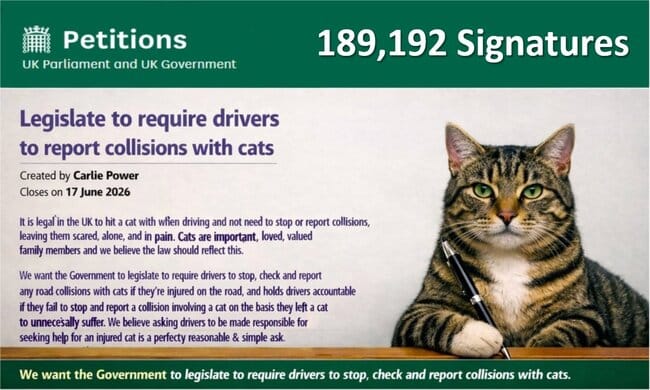
STOURBRIDGE, UK. October 8, 2026 – A significant campaign led by the feline welfare group CatsMatter aims to reshape the legal framework regarding cats injured in road traffic incidents. The campaign has garnered support from 189,192 individuals and will be discussed in Parliament on October 26. This follows a push for a review of whether current road traffic legislation effectively safeguards cats and meets contemporary public expectations, coinciding with World Animal Road Accident Awareness Day on October 10.
Read More
Established by CatsMatter, this annual observance brings together animal welfare organizations to focus on road safety, promote preventative measures, and commemorate the numerous animals—both domestic and wild—affected by vehicle collisions each year.
The impact of road collisions on families across the UK is profound. According to a 2022 Early Day Motion in Parliament citing Petplan data, an estimated 230,000 cats are struck by vehicles each year, many requiring urgent veterinary care to survive.
The petition, identified as e-petition 750612, is now the largest cat welfare petition in UK parliamentary history. The central question for MPs will be whether the law should mandate that drivers report collisions involving cats, similar to requirements for other animals such as dogs and livestock.
Mandy Hobbis, a spokesperson for CatsMatter, emphasized the emotional distress experienced by families when their cats go missing or are injured. She remarked, “For many owners, the hardest part is not knowing what happened to their cat or whether help could have arrived in time,” noting the growing perception of cats as family members. With mandatory microchipping laws in place, she argues that it is time to reassess outdated legal assumptions.
A recent briefing from the House of Commons Library indicates that historically, animals covered under Section 170 of the Road Traffic Act 1988 were categorized as working animals, not pets. However, CatsMatter has provided evidence suggesting a need to reevaluate this distinction, including a 2018 University of Bristol study showing that 65% of surveyed farms housed cats for rodent control, implying a substantial number classified as working animals.
CatsMatter challenges a prior assertion from the Department for Transport that many drivers may be unaware they have struck a cat. A 2023 study from Hungary indicated that only 2.3% of drivers reported uncertainty after pet collisions, suggesting most are aware when such incidents occur.
On September 1, 2026, CatsMatter submitted this evidence to the Department for Transport. The Department acknowledged receipt of the concerns and stated they were under thorough review ahead of the parliamentary debate.
The organization is also advocating for better identification of cats involved in road accidents to facilitate their reunification with owners. Despite government efforts to investigate barriers to this, CatsMatter has not seen evidence that assessing the requirement for reporting cat collisions has been thoroughly examined.
The focus of the upcoming parliamentary debate is whether current evidence is compelling enough to reconsider cats' exclusion from Section 170.
David Gibson, a volunteer strategist with CatsMatter, highlighted the need for a streamlined method for the public to access emergency help for animals. He is working on an initiative proposed as a “999 for animals,” aiming to eliminate confusion over whom to contact in emergencies. He noted that without a centralized information source, delays in assistance can occur, aggravating the situation for injured animals.
Gibson has incorporated Animal Emergency Service Ltd, a not-for-profit aimed at enhancing coordination in animal emergencies, which is set to launch with a crowdfunding campaign on October 30, following the debate in Parliament. Government funding for this initiative is not anticipated.
In conclusion, Hobbis stated that public sentiment strongly favors establishing a modern legal requirement for drivers to stop and assist animals in collisions when safe, mirroring laws in countries such as Italy and Hong Kong.