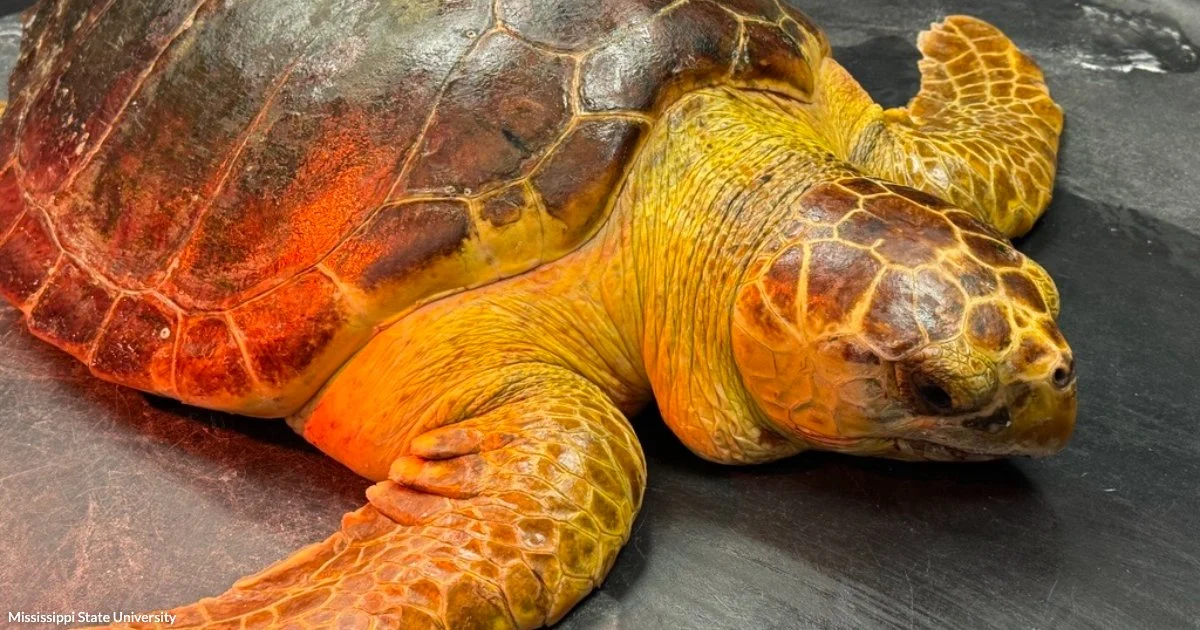
Endangered sea turtles are receiving critical care thanks to a partnership between coastal rescuers and Mississippi State University’s College of Veterinary Medicine (MSU CVM). This collaboration combines field rescue and advanced medical techniques, such as CT imaging, enabling effective treatment for severely injured turtles.
Read More
Recently, two turtles were brought to MSU CVM after being rescued by the Institute for Marine Mammal Studies (IMMS) in Gulfport. One was an adult male Kemp’s ridley sea turtle named Sawyer, the smallest and most endangered species of sea turtle, while the other was Alfonzo, a subadult green sea turtle. Their cases illustrate the complex challenges faced by these endangered animals due to interactions with humans and natural illnesses.
IMMS rescued both turtles from the coast and collaborated with MSU CVM for medical support. According to Debra Moore, DVM, the turtles underwent CT scans to provide clarity on their internal conditions, which is crucial for creating effective treatment plans.
Alfonzo's journey began in November 2025 when he was found in Alabama with a fishing hook embedded in his flipper. Later radiographs indicated additional hidden hooks lodged in his gastrointestinal tract, significantly complicating his condition. Upon arrival at MSU, the clinical team closely monitored the situation; however, it became evident that the hooks were stationary and required surgical intervention. The advanced CT imaging was vital in determining the precise locations of the hooks, aiding the planning for his treatment.
Sawyer's case presented different challenges. Rescued from the Mississippi Sound, he was found with a missing front flipper, which posed severe risks to his swimming and foraging capabilities. Further diagnostics revealed that Sawyer was suffering from pulmonary bullae and lung disease due to a bacterial infection compounded by parasites in his bronchi. The clinical team began treatment with antibiotics while closely monitoring his respiratory status.
Both turtles will need extended care, initially at MSU and later at IMMS, depending on their clinical progress. Moore noted that while some initial work is performed on the coast, cases requiring specialized interventions are transferred back to MSU.
Mississippi State University previously helped another Kemp’s ridley sea turtle named Toast Malone, who underwent endoscopy for a fishing hook found in his stomach. This ongoing collaboration emphasizes the responsibility humans have in safeguarding marine life, especially as coastal environments become more populated.
The partnership between IMMS and MSU CVM highlights the importance of organized responses to marine emergencies. Each coastal state has a designated agency for rescuing sick or injured marine animals, ensuring a network of responders and facilities is available to provide care.
Cases like Sawyer's and Alfonzo's underscore the vulnerability of endangered sea turtles and the need for advanced diagnostic tools to identify hidden injuries. The stories showcase how coordinated rescue efforts can lead to successful rehabilitation, ultimately benefiting both individual animals and the broader conservation of endangered species in our oceans.