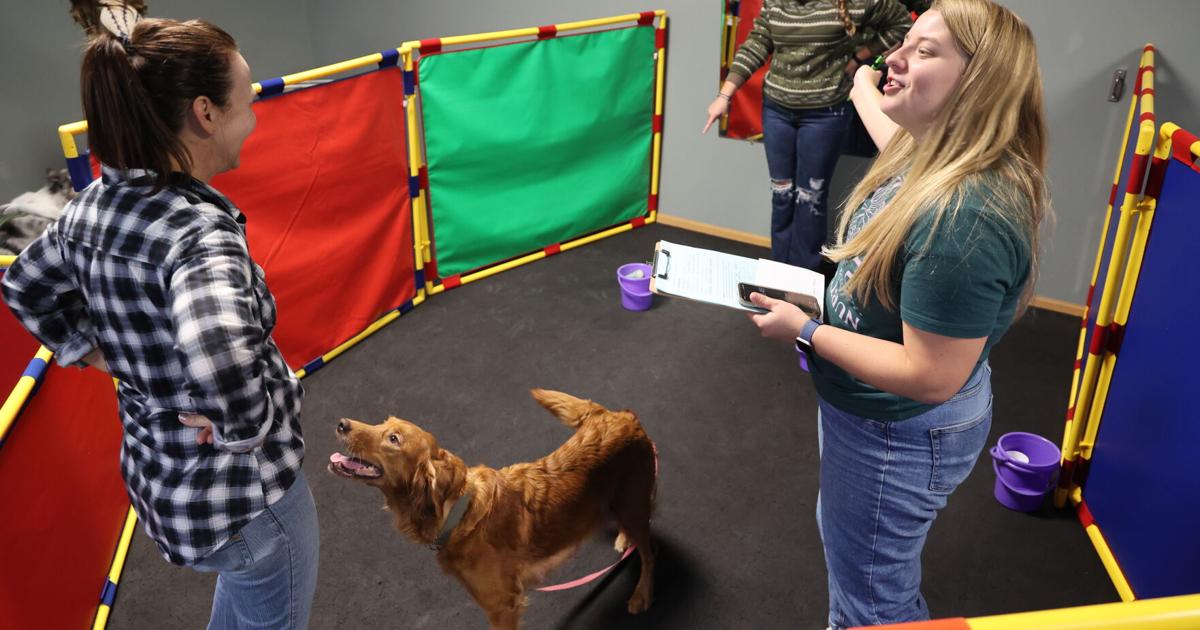
EAU CLAIRE — Students at the University of Wisconsin-Eau Claire engaged in hands-on research focusing on dog behavior and cognition during a recent event at the emBARK dog training facility. The gathering included community members, faculty, and their pets, all contributing to the study of canine cognitive abilities.
Read More
Jack Ingram, a biology student at UW-Eau Claire, explained that the research spans several years and is part of a comprehensive project within their coursework. This year's study specifically aims to assess how well dogs can understand and perform tasks based on human cues, such as pointing.
Jenn Smith, an associate professor and behavioral ecologist, noted the research seeks to understand the extent of dogs' comprehension of human social cues. She questioned whether dogs are truly "man’s best friend" by exploring if they can interpret human intentions and actions.
One of the study's methods involved testing a golden retriever named Selee by hiding food in a bucket while a student pointed to its location. Observations were then made to see if Selee would follow the cue. Psychology student Josh Sawall highlighted additional research focusing on variations in behavior among different dog breeds when responding to social cues.
Smith emphasized that while some breeds excel in these tests, not all dogs or species respond similarly. For instance, she noted that chimpanzees do not pick up on human social cues as effectively as dogs.
The ongoing research has revealed interesting findings related to dog personalities, exploring traits like prey drive and pack drive. Smith is particularly interested in factors such as breed, age, and gender, and how these influence a dog's response to social cues.
Heather Mishefske, owner of emBARK and a certified dog trainer, praised the collaboration with the UW-Eau Claire students, emphasizing the significance of conducting cognitive research in a practical setting. She expressed a commitment to support future research efforts, highlighting the mutual benefits for trainers and students alike.
Ingram shared his enthusiasm for contributing to the research, noting the rewarding experience of participating in a larger academic endeavor while working with dogs.