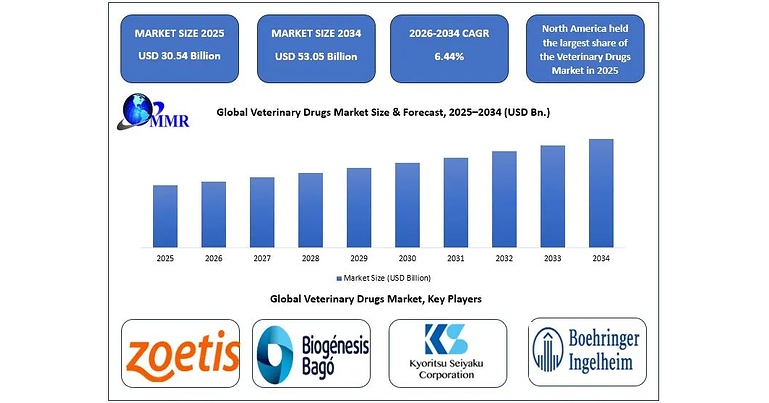
The Global Veterinary Drugs Market was valued at USD 30.54 billion in 2025 and is projected to grow at a compound annual growth rate (CAGR) of 6.44% from 2026 to 2034, reaching USD 53.05 billion by 2034, according to a report by Maximize Market Research.
Read More
Veterinary drugs play a crucial role in preventing diseases, treating infections, managing pain, and maintaining the health of companion animals and livestock. The market encompasses various segments, including anti-infectives, anti-inflammatory drugs, and parasiticides, administered through oral, injectable, and topical methods.
Regulatory frameworks are fostering product development, with the U.S. FDA’s Center for Veterinary Medicine overseeing approved animal drugs through the Green Book. The continuous approval of new drugs is prompting pharmaceutical companies to enhance their veterinary product lines to address a broader range of animal health issues.
The World Organisation for Animal Health (WOAH) highlighted that 47% of reported animal diseases have zoonotic potential, emphasizing the necessity for robust disease monitoring and prevention strategies. Such insights are steering veterinary pharmaceutical companies towards expanding their product portfolios and innovating new therapies for both companion animals and livestock.
The demand for effective animal healthcare is rising due to increasing animal disease risks. In 2024, incidents of bird flu in mammals surged more than double compared to the previous year, amplifying the need for effective veterinary treatments. As a response, companies are enhancing their offerings in anti-infectives, parasiticides, and anti-inflammatory drugs.
However, the market faces challenges, including strict regulatory standards related to drug safety, efficacy, and production quality, which can lengthen development timelines and increase costs, particularly for smaller enterprises. In the U.S., the FDA categorizes animal drug applications into several types that require rigorous compliance before commercialization.
Amid these challenges, the trend toward preventive healthcare and innovative therapies, such as long-acting and specialty treatments, presents opportunities for growth within the veterinary pharmaceutical sector. Recent FDA approvals, like the extended-release formulation BRAVECTO QUANTUM for flea and tick control in dogs, illustrate the industry’s shift towards more convenient, long-term treatments.
Antimicrobial resistance is also reshaping the market, prompting the development of alternative therapies and vaccines. Data from WOAH indicated a decline in antimicrobial usage in animals by 5% from 2020 to 2022, signifying a global shift toward responsible drug use.
The Global Veterinary Drugs Market is segmented by product types, animal preferences, methods of administration, and distribution channels, with North America currently leading in market share due to significant spending on companion animals, advanced veterinary services, and substantial livestock production. Meanwhile, the Asia Pacific region is exhibiting rapid growth fueled by rising pet ownership, substantial livestock populations, and improving veterinary healthcare infrastructure.
Key players in the market include Zoetis Services LLC, Boehringer Ingelheim International GmbH, and Merck & Co., among others, who are increasingly focusing on product innovation and expansion into emerging veterinary applications. With growing competition, the focus on developing targeted treatments, preventive healthcare solutions, and long-acting formulations is poised to further shape the landscape of veterinary pharmaceuticals.