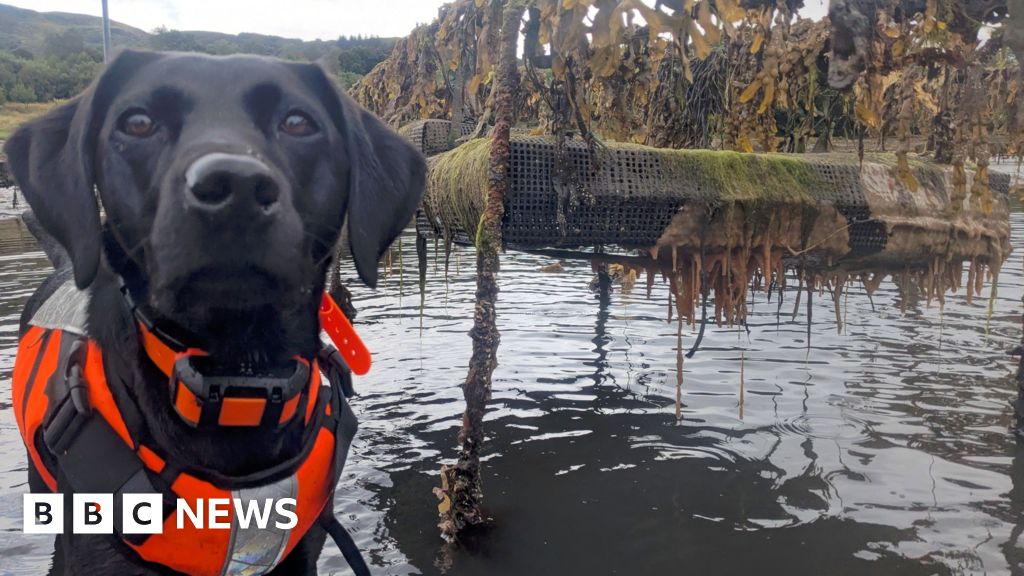
A working dog from the Scottish Highlands has been recognized as Animal of the Year for her role in locating the invasive marine species known as the carpet sea squirt, informally called "sea vomit." This organism poses a significant threat to coastal ecosystems and economies. Sgiath, a black Labrador, partners with her owner, marine ecologist Dr. Texa Sim, to find and report hundreds of colonies of the carpet sea squirt, which can suffocate native species if left unchecked.
Read More
Sgiath, believed to be the first dog in the UK trained to hunt sea squirts, operates at low tide. Dr. Sim, based near Glencoe and a longtime owner of Sgiath, expressed pride in her dog's capabilities, stating, "She's a natural." Sgiath has a remarkable talent for problem-solving and learning quickly, which has been a joy for Dr. Sim to observe.
Originally trained as a mountain rescue dog, Sgiath's aptitude led Dr. Sim to explore how her skills could assist in marine conservation. The six-year-old Labrador is now adept at identifying the smell of the carpet sea squirt, enabling her to help Dr. Sim locate this elusive creature, which often blends into seaweed and other coastal structures.
Dr. Sim initially approached this project as an experiment to see if dogs could be utilized in marine conservation. Her efforts have proven successful, as Sgiath's precision in spotting sea squirts has exceeded Dr. Sim's expectations. Dog-scent detection is often employed in terrestrial conservation efforts, such as tracking endangered species.
The carpet sea squirt, formally known as Didemnum vexillum, first appeared in the UK in 2008, arriving from Japan and spreading to various coastal areas. It can reproduce rapidly in warmer months, raising concerns about further proliferation due to climate change. Marine biologist Dr. Martyn Kurr from Bangor University emphasized that invasive species like the carpet sea squirt can outcompete local wildlife and disrupt aquaculture, creating significant economic costs.
Training Sgiath for both mountain rescue and marine conservation has demanded intensive effort from Dr. Sim and her dog. In the mountains, Sgiath is trained to bark and make herself known when locating missing hikers. In contrast, for marine work, she uses a quieter method known as a "passive indication" by remaining still when she detects the sea squirt.
In a recent conversation over Zoom, Dr. Sim noted that Sgiath enjoys relaxing at home when not working. Both Sgiath and Dr. Sim's younger Labrador, Uisage, share a strong motivation for their tasks, driven by play and rewards. Dr. Kurr remarked on the potential for sniffer dogs to identify subtle changes in marine environments, highlighting Sgiath's award as a well-deserved recognition of her contributions.