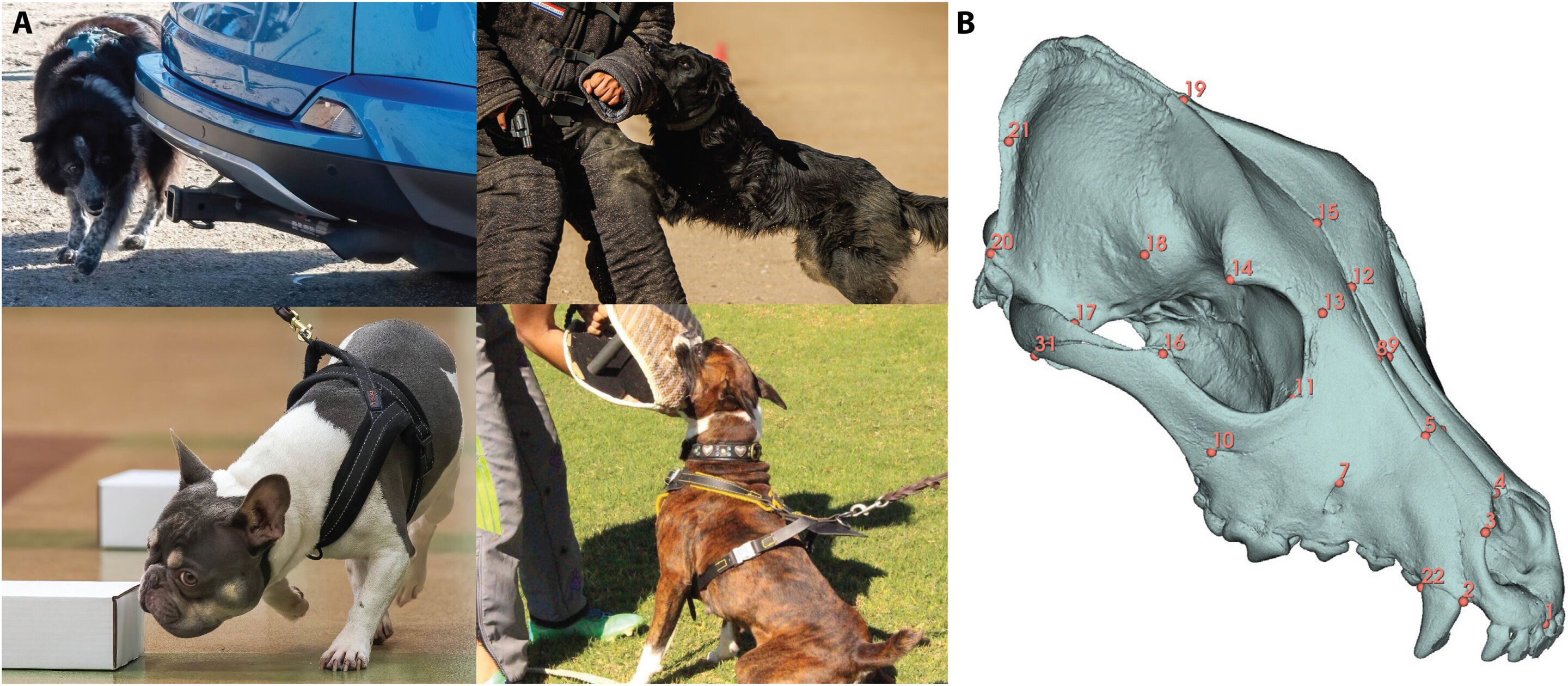
A recent study challenges long-held beliefs about the functional specialization of dog breeds based on their skull morphology. Conducted by researchers Nicholas Hebdon and Lindsay Waldrop, the study was published in Science Advances on January 29, 2025, and utilized advanced 3D reconstruction techniques to analyze 117 skulls from 40 domestic dog breeds alongside 18 wild canid species.
Read More
The findings reveal significant overlap in skull shapes across different breeds and functional categories, indicating that the morphological traits commonly associated with specific tasks—such as bite work and scent detection—are not as distinct as previously assumed. This suggests that selective breeding has prioritized aesthetic traits rather than functional morphology. Waldrop, an assistant professor of biological sciences at Chapman University, noted that while dogs have been bred to perform tasks like herding and hunting, their skull structures do not support the idea that they are specialized for tasks involving biting or scent work.
The study examined breeds commonly employed in law enforcement and military applications, where dogs are trained for patrol and detection duties. Despite the expectation of observable differences in skull morphology among breeds, the results indicated that domesticated dogs exhibit diversity in skull shapes, yet all breeds had high overlap in features relevant to functional tasks.
Bite-force measurements showed no significant differences between breeds bred specifically for biting and those bred for other roles. Waldrop highlighted misconceptions surrounding dog aggression, particularly regarding breeds like pit bulls, which are often blamed for attacks. The study asserts that there is no structural difference that makes these dogs more dangerous than others of similar size.
Similarly, breeds selected for scent work lacked distinct olfactory morphological traits compared to other breeds. The only exception noted was among brachycephalic breeds, such as bulldogs, which have shorter snouts but are not functionally specialized; this trait stems more from human aesthetic preferences than from task performance.
Hebdon, the lead author, expressed surprise at the overall similarity of most dog skulls, noting that despite extensive breeding for visual variation, clear morphological groupings were absent. In contrast, it was found that the skull morphologies of wild canids like wolves and foxes exhibit adaptations aligned with hunting and scenting needs.
Notably, some terrier breeds display skull shapes similar to certain foxes, indicating a functional resemblance related to small prey pursuit. The research suggests that the observable behaviors associated with different breeds may be more significant indicators of performance than morphological traits. Behavioral traits, which are known to have a hereditary component, may be more critical for selecting dogs for specific tasks in fields such as law enforcement and search and rescue.