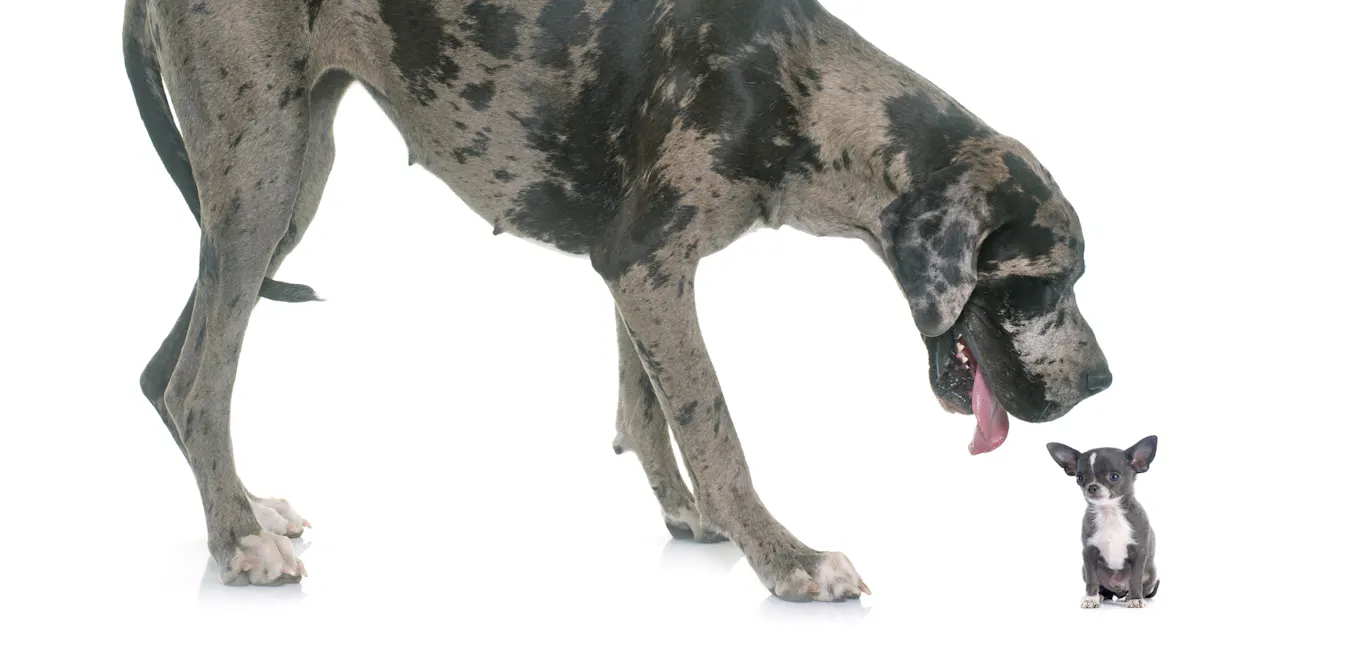
Domestic dogs display remarkable diversity, with sizes ranging from chihuahuas to great danes and various unique features such as flat faces and long muzzles. Traditionally, this variety has been attributed to Victorian kennel clubs, which emerged around 200 years ago and are credited with formalizing selective breeding for modern dog breeds.
Read More
However, new research published in Science suggests that this explanation is incomplete. Evidence shows that dogs were already diverse in skull shape and size over 10,000 years ago, long before the establishment of kennel clubs.
The study challenges the notion that directed breeding solely created the physical variety in dogs today. Instead, it highlights that early dogs evolved a broad range of forms shortly after domestication, a diversity that has been continually shaped by thousands of years of interaction with humans.
Scholars have long sought to determine when wolves became domesticated dogs. The human-wolf relationship extends back to the last ice age, possibly reaching as far as 30,000 years ago, but the precise timing of domestication remains uncertain. Dogs are unique as the first species to be domesticated by humans, predating agricultural development.
The research employed geometric morphometrics to analyze the shapes of skulls in three dimensions, allowing researchers to detect subtle morphological changes over time. The team analyzed 643 skulls from both ancient and modern dogs and wolves, covering a span of 50,000 years from northern hemisphere sites to chart the emergence and evolution of domestic dogs.
The findings revealed that the earliest skulls clearly exhibiting domestic traits date back to around 11,000 years ago from the Mesolithic site of Veretye in Russia. By this time, dogs had not only diverged from wolves in skull shape but had started to diversify among themselves, exhibiting a variety of skull sizes and forms influenced by local environments and human preferences.
Some early dogs had skull shapes not associated with modern breeds, indicating potential lineages that no longer exist. Although the extreme skull shapes seen in some current breeds were absent, the variation present in these ancient dogs accounted for a significant portion of the diversity seen in today’s breeds.
This discovery aligns with genetic studies indicating separate lineages among early dog populations by the Neolithic period (8,000–5,000 years ago). Some of these lineages still exist in modern breeds, while others may have vanished or been altered through interbreeding.
The findings contribute to a growing understanding that the domestication of dogs was a gradual process with significant regional variations. Genetic evidence suggests that major dog lineages were distinct by 11,000 years ago, indicating that domestication began earlier than previously thought.
Debates continue regarding the exact timing of domestication, with some studies suggesting relationships between humans and canids date back over 30,000 years. However, the current research found no domesticated dogs among the 17 Late Pleistocene skulls studied, suggesting these may not extend as far back as hypothesized. The earliest dogs likely resembled wolves closely, though the duration of this resemblance is still unclear.
Further specimens from the critical period between 25,000 and 11,000 years ago, especially from lesser-represented areas like central and south-west Asia, are necessary to enhance our understanding of dog domestication. This research reinforces the notion of an ancient evolutionary relationship between humans and dogs that began shortly after domestication. Ultimately, the history of dogs mirrors that of humans, reflecting shared migrations, ecological changes, and societal evolution.