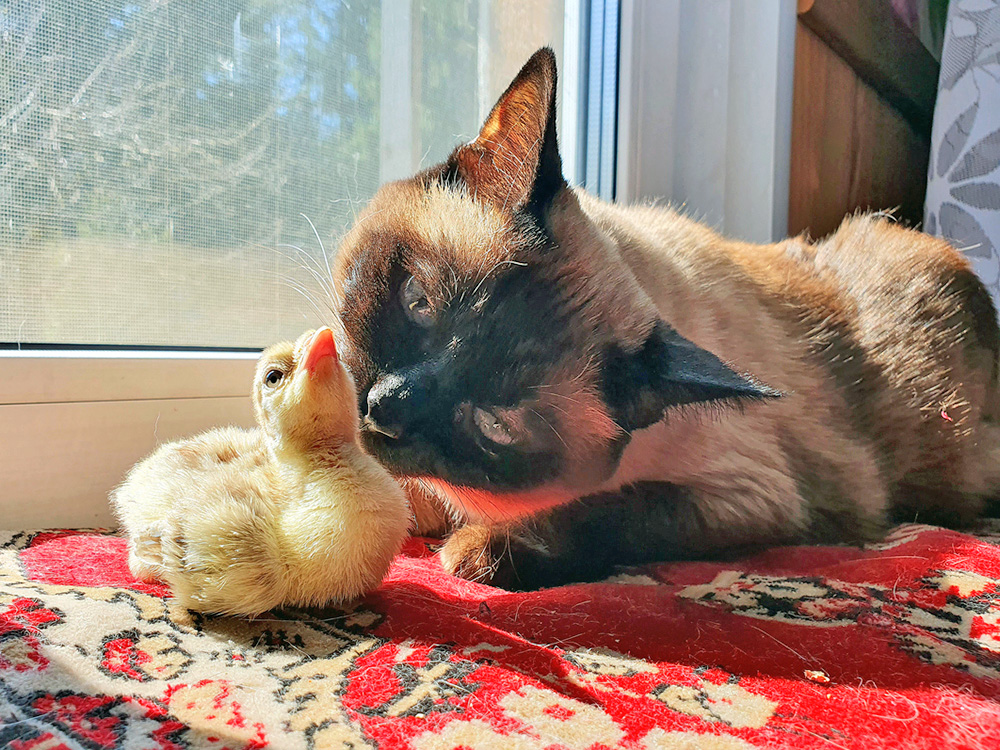
Cats are often viewed as aloof creatures, yet they exhibit nurturing behaviors that reveal a caring side. Many cat owners will attest to the unique affection that cats show both towards each other and various species, including orphaned kittens and even puppies or rabbits.
Read More
The mothering instinct in some cats is so pronounced that they will immediately care for orphaned animals, whether they belong to their species or another. Stephen Quandt, a certified cat behaviorist from Animal Care Centers of New York (ACC), notes that lactating mother cats often accept orphaned kittens readily. Dr. Kathryn Dench, a veterinarian and chief scientific advisor at Paw Origins, has observed cats adopting various orphaned species, including puppies and ducks, providing nurturing behaviors such as grooming and nursing.
These cross-species relationships frequently capture public interest on social media, illustrating a remarkable bond that transcends species differences. Quandt suggests that the act of giving birth triggers a strong instinctual response in mother cats, akin to running a program solely focused on caring for young.
Contrary to the stereotype that cats are poor mothers, most are instinctively equipped with strong maternal skills, which include grooming, nursing, and protecting their kittens. Dr. Dench confirms that maternal instincts remain significant even in domestic environments. While some cats may reject their young, the majority respond promptly to their kittens' needs. As the kittens grow, mother cats eventually wean them, marking a natural progression in parenting.
Cats can also forge deep friendships across species. Poet James Gaynor shares the bond between his cat, Bob Dylan Thomas, and his dog, Mr. Margaret Atwood, highlighting how such connections can develop organically, even across predator-prey lines. Dr. Dench reminisces about her own childhood experiences of a close bond between her cat and a pet rabbit, showcasing a harmonious coexistence despite natural instincts.
Though interspecies relationships can be beautiful, they are not without risks. Dr. Dench warns that a cat's predatory instincts can emerge unexpectedly, particularly in stressful situations. Hence, supervision is crucial when different species interact, especially if one may be perceived as prey.
When considering introducing another animal to a cat, it is important to recognize each cat's temperament. A gradual and cautious introduction process is essential for safety and comfort, particularly with prey species. Carl suggests starting with scent-swapping before visual meetings and using barriers if necessary to ensure a safe environment.
While many cats can form strong emotional bonds, it is essential to remember that their instincts can be unpredictable. Each cat is unique, and ensuring safe interactions across species requires careful management. As we appreciate the love and care our cats exhibit, it's vital to remain aware of their natural instincts.