DURHAM, N.C. – A study led by Duke Health has shed light on the cellular mechanisms involved in the allergy treatment known as “rush desensitization.” This approach involves administering increasing doses of an allergen over a short period, such as peanuts or bee venom, to help patients develop tolerance to the substance.
Read More
Dr. Soman Abraham, senior author of the study published on September 26 in the Journal of Clinical Investigation, explains that while the effectiveness of this method has been known for over a century, the underlying biological processes were not clearly understood. Abraham, who is a professor in several departments at Duke University School of Medicine, noted that rush desensitization can allow individuals with severe allergic reactions to tolerate brief exposures to harmful allergens.
The findings could pave the way for improved therapies for managing serious allergies to foods, dust, pollen, medications, and insect stings, which affect millions of people annually.
The research team, which included Dr. A. Wesley Burks, who previously worked on peanut allergies in children, used various experiments to analyze cellular responses during allergic reactions and following rush desensitization. They found that allergy symptoms stem from the immune system’s mast cells, which release inflammatory chemicals such as histamines when exposed to allergens.
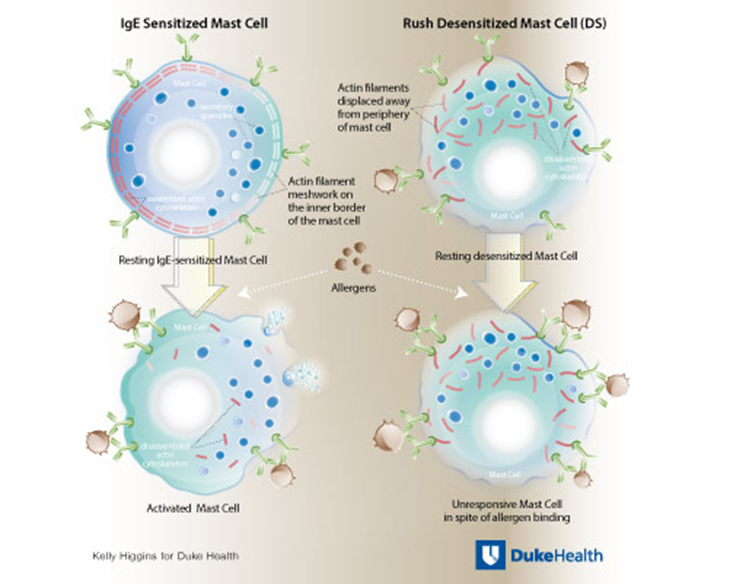
Upon first exposure to an allergen, the body produces immunoglobulin E (IgE) antibodies, which bind to the allergen during subsequent exposures. This binding activates mast cells, triggering the release of granules containing inflammatory substances, resulting in allergy symptoms like sneezing and swelling. In severe cases, this can lead to life-threatening reactions.
Historically, it was believed that rush desensitization disrupts the mast cells' response to allergens. The current study reveals that this disruption happens at the level of the actin filaments inside mast cells. When allergens are present, these filaments break down and congregate at the cell's center, facilitating granule release. However, during rush desensitization, the actin misaligns without triggering allergic reactions, allowing for tolerance.
This mechanism offers potential pathways for developing new drugs that could extend the effects of desensitization therapy by targeting the actin behavior. Lead author W.X. Gladys Ang, a graduate student at Duke, emphasizes that understanding this mechanism could lead to treatments that help individuals maintain longer periods of allergen tolerance.
The study was supported by the National Institutes of Health.