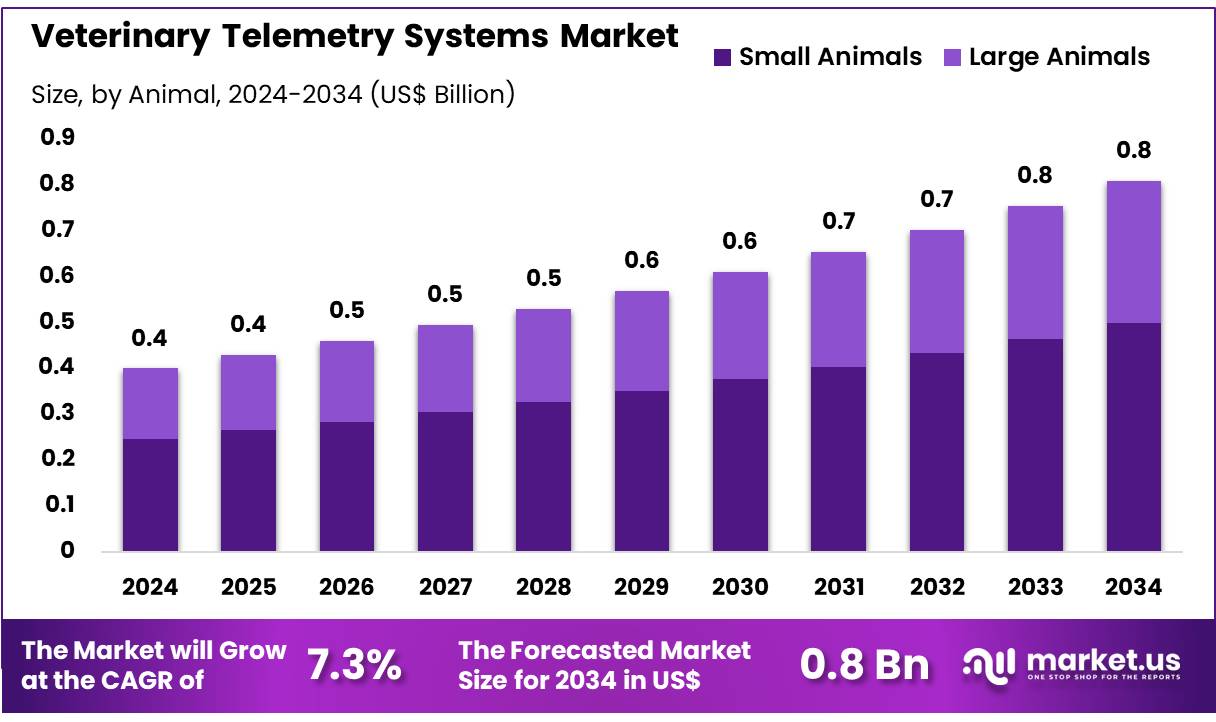
The global veterinary telemetry systems market is expected to grow from approximately US$ 0.4 billion in 2024 to US$ 0.8 billion by 2034, achieving a compound annual growth rate (CAGR) of 7.3% from 2025 to 2034. North America led the market in 2024, capturing over 38.9% of the share with revenues of US$ 0.2 billion.
Read More
Adoption of veterinary telemetry systems is on the rise among veterinary hospitals, research institutions, universities, and animal health organizations. These systems facilitate continuous physiological monitoring of animals, allowing for remote tracking of vital parameters such as heart rate, blood pressure, electrocardiograms (ECG), body temperature, and respiratory rate without restricting animal movement. This capability enhances animal welfare by minimizing stress and providing more precise data for diagnostics and treatment evaluations.
The increasing focus on animal health surveillance and precision veterinary care is driving the adoption of telemetry technologies. The U.S. Department of Agriculture’s Animal and Plant Health Inspection Service emphasizes that comprehensive surveillance is essential for animal health and public safety. APHIS collaborates with a national network of veterinary partners to address emerging diseases and bolster livestock health programs, thereby increasing the demand for advanced monitoring technologies.
In veterinary and agricultural research, the USDA National Agricultural Library has promoted the development of telemetry systems that can gather GPS and physiological sensor data to enhance early disease detection and continuous health monitoring, thus reducing reliance on manual observation. The National Animal Health Monitoring System (NAHMS) also conducts nationwide studies to gather valuable health data concerning livestock and poultry, advocating for evidence-based veterinary management and the uptake of digital monitoring solutions.
Key statistics reveal that in 2024, the market's dominant segments included Vital Signs Monitors, which held 31.3% of the market share, and Compact/Tabletop systems, which accounted for 43.1%. The Respiratory application segment led in revenue contribution, making up 36.4% of the global market in the same year. Additionally, the Small Animals segment represented 61.7% of total revenue, with Veterinary Hospitals and Clinics comprising 68.9% of market revenue.
Regionally, North America maintained its leading position in 2024 due to its robust veterinary healthcare infrastructure and regulatory oversight from agencies like the FDA, which ensures the reliability and safety of veterinary monitoring equipment. In contrast, the Asia Pacific region is anticipated to exhibit the fastest growth rate driven by increasing livestock production and improved animal disease surveillance programs.
Emerging trends in the market include the adoption of AI-powered veterinary technologies and the establishment of Animal and Veterinary Innovation Centers by the FDA, aimed at accelerating the development of next-generation veterinary devices. The FDA is also enhancing the Veterinary Innovation Program to expedite regulatory pathways for innovative veterinary products.
The scope of telemetry systems includes applications in veterinary hospitals for continuous monitoring of critically ill patients, remote livestock health monitoring, and efficiency in biomedical research. These technologies support early disease detection, improve clinical decision-making, and ultimately enhance animal welfare.
Overall, the veterinary telemetry systems market is set for sustained growth as digital monitoring technologies become integral to clinical outcomes and animal health management, supported by ongoing regulatory initiatives and rising demand for precision veterinary medicine.